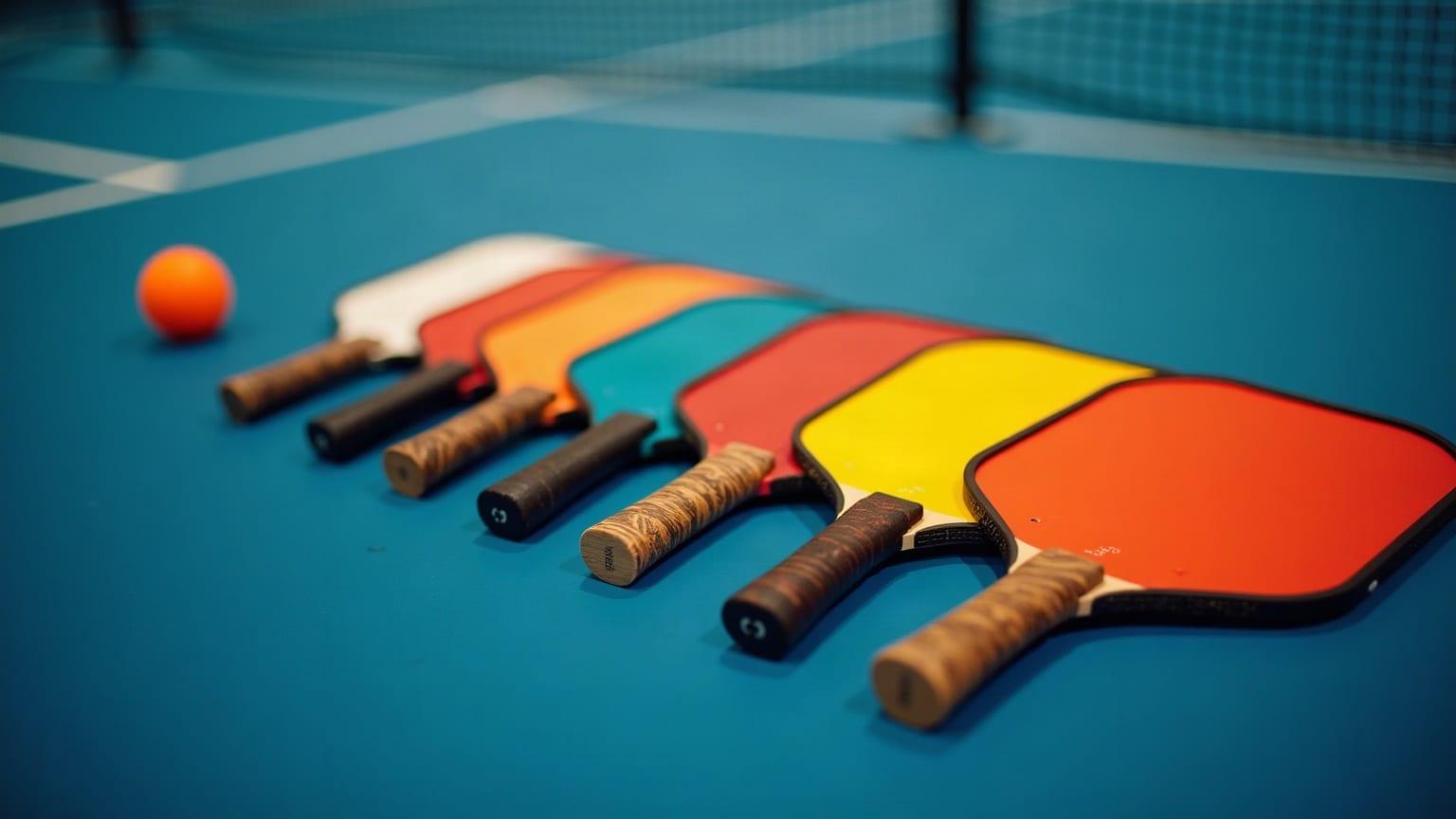
A pickleball paddle wall can be overwhelming before a first purchase — dozens of brands, a spread of prices, and specs like "16mm polymer core" that mean nothing until someone explains them. Pickleball for Beginners covers getting started with the sport itself; this guide is narrower, and answers the question that actually comes up once someone's ready to buy: what do weight, grip size, core material and face material actually change about how a paddle plays, and which of those matters most for someone who hasn't bought one before.
Weight: the factor that affects everything else
A paddle's weight is usually the first spec listed and the one with the biggest effect on how a game feels. Paddles generally fall into three loose bands: lightweight paddles, roughly under 7.3 ounces, swing fast and are easy on the arm and shoulder over a long session, but they generate less power on their own, so a player has to supply more of the pace themselves. Midweight paddles, roughly 7.3 to 8.4 ounces, are the market's default for a reason — they balance maneuverability at the net against enough mass to drive a ball without much extra effort, and most all-around recommendations for a first paddle land somewhere in this range. Heavier paddles, 8.5 ounces and up, hit harder with less swing effort but are more tiring to control over a long match and slower to reset between fast exchanges at the net, which matters more in doubles than it might sound.
There's no single "correct" weight, and the right choice depends more on a player's own arm and playing style than on any one number. Someone who already has elbow or shoulder discomfort from another racquet sport is usually better served by a lighter paddle regardless of what else they read about power, since paddle weight is one of the more commonly cited factors in overuse injuries like "pickleball elbow." A first-time buyer without a specific physical reason to go lighter or heavier does fine starting in the middle of the range and adjusting on a second paddle once they know what they actually want more of — power or control.
Weight alone also doesn't tell the whole story, because two paddles listed at the same ounce figure can still feel different depending on where that weight sits. A paddle with more mass concentrated toward the head, out past the throat, generates extra pop on groundstrokes but takes slightly longer to bring back into position for a fast exchange at the net, while a handle-weighted paddle of the same total weight feels quicker and more maneuverable up close at the cost of a little raw power. That distinction, sometimes called swingweight or balance, is a second-paddle consideration rather than a first-purchase one, but it explains why two paddles with an identical number on the box can feel noticeably different in a hand.
Grip size: smaller than it looks
Grip size is measured as the circumference of the handle, and it typically runs from about 4 inches to 4.5 inches across most paddles on the market — noticeably smaller in the hand than a tennis racquet grip, which is part of why a paddle borrowed from someone else's bag can feel subtly wrong even if the weight seems fine. A grip that's too large forces a player to squeeze harder to control the paddle, which tires the forearm faster and can contribute to the same overuse strain that a too-heavy paddle causes. A grip that's too small lets the paddle twist slightly in the hand on off-center contact, which shows up as mishits that feel like a timing problem but are actually a fit problem.
A rough way to check fit without a specialty tool: with the paddle gripped normally, there should be about a finger's width of space between the fingertips and the base of the palm when wrapped around the handle. Most manufacturers offer only one or two grip sizes per paddle model, so grip size often narrows the field of realistic options before weight or materials even enter the decision, especially for players with smaller or larger hands than average.
Core material: what's actually inside the paddle
The core is the material sandwiched between the two paddle faces, and it does more to determine how a paddle feels and sounds than any other single component. Polymer cores, usually a honeycomb structure of plastic or polypropylene, are the most common material on the market today: they're relatively quiet on contact, forgiving on off-center hits, and durable over months of regular play, which is most of why they've become the default choice for beginner and intermediate paddles alike.
Nomex cores, an older material made from a paper-based honeycomb coated in resin, hit harder and louder than polymer and can generate more pop on a shot, but they're noticeably less forgiving of a mishit and wear down faster with regular use. Aluminum cores, an even older option, are light and offer good touch on soft shots but tend to have a smaller effective sweet spot than polymer, making consistent power harder to find. For a first paddle, polymer's combination of forgiveness and durability is the safer starting point; nomex and aluminum are both still sold, but they suit a player who already knows they want a specific trade-off polymer doesn't offer.
Face material: what the ball actually contacts
The face is the outer surface layer bonded to the core, and it's usually fiberglass (sometimes called composite) or carbon fiber (also sold as graphite). Fiberglass faces tend to flex slightly more on contact, which produces more natural power and a larger forgiving sweet spot — a good match for a beginner still learning to time contact consistently. Carbon fiber faces are stiffer and lighter for a given strength, which trades some of that built-in power for more precise control and a more consistent response across the face, and they're common on paddles marketed toward more advanced or control-focused players.
Some paddle faces are also textured, with a slightly rough or grit-coated surface designed to grab the ball briefly on contact and impart more spin. Texture matters more once a player is already comfortable controlling depth and direction; it's a reasonable thing to look for on a second or third paddle, but not a deciding factor worth agonizing over on a first one.
Thickness of the whole paddle — core and both faces combined — is a related spec worth a brief mention, since it's often listed alongside weight on a product page. A thicker paddle generally offers more control and a quieter, more dampened feel on contact, while a thinner paddle tends to feel livelier and can generate more pop for the same swing. Neither thickness is inherently better; it's one more variable that mostly rewards experimentation once a player already knows whether they lean toward control or power in the rest of their game.
Paddle size, and why there's a rule about it
Regulation paddles are limited by a combined-dimension rule rather than a flat length or width limit: under the official USA Pickleball rulebook, a paddle's length plus its width, including any edge guard and butt cap, cannot exceed 24 inches total, and length alone is capped at 17 inches. In practice, that rule leaves manufacturers room to trade length for width or vice versa, which is why some paddles on a store shelf look noticeably longer and narrower than others while both are fully legal for sanctioned play. A longer paddle generally extends reach and can add swing speed, while a wider paddle offers a larger hitting surface and a bigger margin for off-center contact — most all-around recommendations for a first paddle stick closer to a standard, roughly-square shape rather than either extreme.
None of these dimension rules affect a casual, non-tournament game in any practical way; they mostly matter for anyone planning to play in a sanctioned league or tournament where paddle legality gets checked, which is worth knowing before investing in a specialty shape.
Mistakes worth avoiding on a first purchase
A handful of buying mistakes come up often enough to call out directly. Buying the heaviest paddle available on the assumption that more mass automatically means more power ignores how much control and comfort matters over a full session — a heavy paddle that tires an arm out by the second game usually loses more points to late reactions than it wins from raw pace. Buying based on a grip size that "should" fit rather than one actually measured against the hand is another common miss, since grip is one of the few specs that can't really be judged from a photo or a spec sheet alone.
It's also worth checking whether a paddle appears on USA Pickleball's list of approved equipment before buying one intended for league or tournament play, since an unapproved paddle — often an unusually thick or oversized model marketed for extra power — can get a player disqualified from sanctioned matches even if it's perfectly fine for a casual game with friends. That distinction rarely matters for someone just starting out, but it's worth knowing before a paddle bought for casual play turns out to be the wrong one to bring to a first league night.
What actually matters most for a beginner
Faced with all of the above, a first-time buyer can reasonably ignore most of it. Weight in the midweight range, a grip that matches hand size rather than a marketing claim, and a polymer core with a fiberglass face cover the overwhelming majority of what a beginner needs, and that combination happens to describe most of the paddles sold specifically as "beginner" or "starter" models by major brands. Chasing carbon fiber faces, unusual paddle shapes, or a specific pro player's exact setup before a first season of regular play is money spent on refinements a beginner generally can't feel the benefit of yet, since those differences show up most in players who already have a consistent, repeatable swing.
The more useful early investment is simply playing enough games to notice a specific complaint — "my arm gets tired," "I keep mishitting off-center," "I want more spin" — and then shopping for a second paddle that solves that particular problem, rather than trying to guess the ideal paddle before ever playing a match.
Trying a paddle before buying one
Pickle N Pins in Metairie has paddles available to rent on site, which is a genuinely useful way to test a weight and grip combination in a real game before committing to a purchase rather than guessing from a spec sheet alone. Pickleball at the venue is played indoors on courts for beginners, intermediate and advanced players, and current rental and court rates are on the pricing page rather than repeated here. Anyone who wants structured instruction alongside picking the right equipment can also look at pickleball lessons rather than figuring out grip and swing mechanics alone.
The bottom line
Weight affects arm fatigue and power more than any other single spec, grip size affects control and injury risk more than most players expect, and core and face materials trade off forgiveness against precision in ways that matter more once a player already has a consistent swing. A midweight, polymer-core, fiberglass-face paddle with a grip that actually fits the hand covers most of what a beginner needs, and it's a far more reliable starting point than chasing the exact paddle a top player uses before ever having played a full season of games.