Pickleball is played with a solid paddle and a hard plastic ball, on a court smaller than a tennis court, and it can be played as singles or doubles. The core rules are simple enough that most beginners are rallying comfortably within their first session, which is a big part of why the sport has spread as fast as it has.
What pickleball actually is
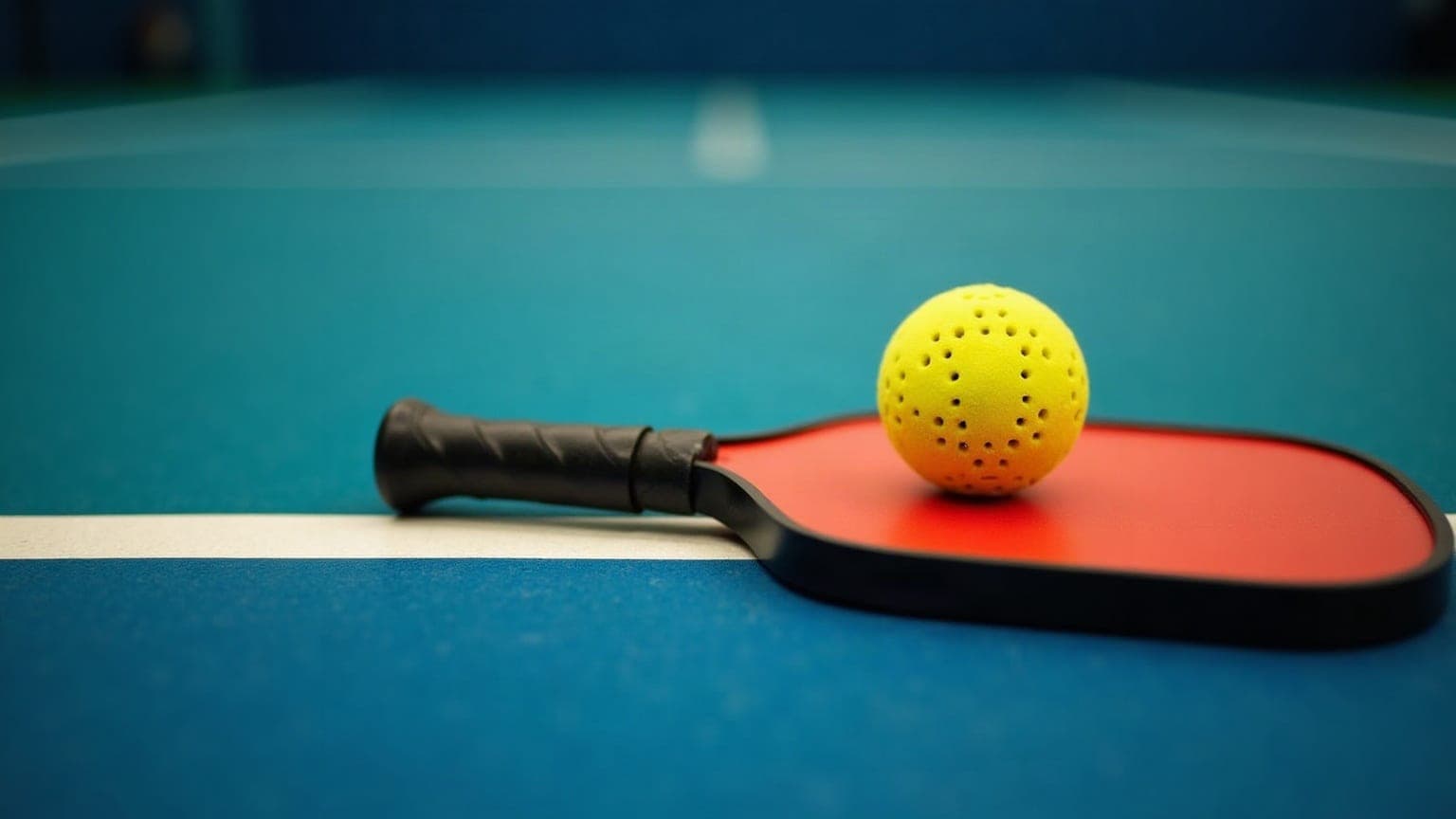
Pickleball sits somewhere between tennis, badminton and table tennis, borrowing a little from each without copying any of them exactly. The paddle is solid, not strung like a tennis racquet, which means there is nothing to restring and less to maintain. The ball is hard plastic with holes in it, closer to a wiffle ball than to a tennis ball, and it does not bounce nearly as high or travel nearly as fast through the air, which is a large part of why the sport feels approachable even to someone who has never played a racquet sport before.
The court itself is a fraction of the size of a tennis court, which shortens the distance a player has to cover and shortens rallies just enough that a beginner is not gasping for air thirty seconds into their first point. It can be played one-on-one as singles, but it is most commonly played as doubles, two players per side, which is part of why it works so well for mixed groups: four people of very different skill levels can share a court and each hit a meaningful share of the shots, rather than one strong player dominating a rally the way they might in singles.
Part of what has made the sport spread so quickly is exactly this combination: a smaller court that is easier on the body, a lighter, slower ball that is more forgiving to react to, and a doubles-first culture that makes it a social activity as much as a competitive one. It also means the equipment cost and the physical demands are both lower than they are for tennis, which is a large part of why it has become common to see a wide range of ages sharing the same court, from teenagers to retirees, in the same match.
The court, the net and the kitchen
A pickleball court is divided by a low net, similar in idea to a tennis net but noticeably shorter. Lines mark out the boundaries for singles and doubles play, along with a service area on each side split down the middle, similar in concept to a tennis service box.
The non-volley zone, or "the kitchen"
The single most important line on the court is the one marking the non-volley zone, almost universally called "the kitchen" by players. It is the section of the court closest to the net on each side, and the rule attached to it is simple: you cannot hit the ball out of the air, called a volley, while any part of your body is touching that zone. You have to either let the ball bounce first, or step back out of the kitchen before volleying it.
That one rule shapes most of the strategy in the sport. Without it, the game would reward whoever can plant themselves at the net and smash every ball downward; with it, players have to earn their way forward and time their approach, which keeps rallies from turning into a pure power contest. Learning exactly where that line is, and building the habit of checking your feet before you swing, is usually the first real skill a new player picks up, and it is worth deliberately practicing before your first real match.
A related point that trips up newcomers: it is fine to stand inside the kitchen at any time, and fine to hit a ball that has already bounced while standing inside it. The rule only stops a volley, a ball struck before it touches the ground, while any part of you is touching that zone, including momentum carrying you across the line right after you hit the shot. That distinction, between where you can stand and what you can do while standing there, is worth repeating a few times before your first game, since it is the single most common way a beginner loses an otherwise good point.
Serving and the double-bounce rule
The serve itself
Play starts with an underhand serve, hit diagonally across the court into the opponent's service area, similar in concept to a tennis serve but struck below the waist rather than overhead. The serve has to clear the net and land in the correct diagonal box; unlike some racquet sports, there is no advantage to serving as hard as possible, since placement matters far more than pace on a court this size.
The double-bounce rule
After the serve, the ball has to bounce once on the serving side and once on the receiving side before either player is allowed to volley it. This is called the double-bounce rule, and it is one of the first habits a new player has to build, since instinct from other racquet sports often says to rush the net right after serving. Once both of those bounces have happened, either side can choose to volley the ball out of the air or let it bounce again, and that is the point where the game opens up into the faster exchanges near the net that make pickleball fun to watch.
Together, the double-bounce rule and the kitchen line are designed to do the same job from two different angles: neither team can simply plant itself at the net from the very first shot of the point. The serving team has to wait for two bounces before advancing, and once everyone is up near the net, the kitchen line stops either side from smashing every ball straight down. The net effect is a game with a genuine back-and-forth setup phase before the faster exchanges begin, rather than a sport decided entirely by who reaches the net first.
Scoring, in plain terms
Traditional scoring
Games are commonly played to 11 points, and a side has to win by at least 2. In traditional pickleball scoring, only the serving side can score a point; if the receiving side wins a rally, no one scores, and the serve simply passes to the other side instead. That detail surprises a lot of newcomers, since it means a long, well-played rally you lose while receiving costs you nothing except the chance to serve next.
Rally scoring
Some newer formats and some tournaments use rally scoring instead, where either side can score a point on any rally regardless of who served. Rally-scored games also tend to run to a different point total. It is worth checking which scoring style is in use before a match starts, since it changes both the pace of a game and the strategy around when a team can afford to play it safe.
Neither system is more correct than the other; they are just different conventions, similar to how different card games score hands differently without one being the "real" version. A casual open-play session is more likely to use traditional scoring since it is the version most players already know, while a specific league or tournament format might specify rally scoring in its own rules. Asking before a match starts takes a few seconds and avoids a mid-game argument about whether a rally you just lost cost you a point.
What to bring, and what you do not need to know yet
You need a paddle and comfortable athletic shoes with good grip, the same kind of footwear you would wear for tennis or any other court sport. Beyond that, you do not need to memorize every rule before your first game. Most people pick up the double-bounce rule and the kitchen line simply by playing a few points and getting corrected along the way, and finer strategy, like shot placement, when to approach the net, and how to communicate with a doubles partner, comes with time on the court rather than from reading about it in advance.
Common beginner mistakes
A handful of mistakes show up in almost every beginner's first few sessions, and none of them take long to fix once someone points them out:
- Standing at the kitchen line and volleying anyway. It is easy to forget exactly where the non-volley zone ends, especially mid-rally. If in doubt, step back before you swing.
- Serving too hard, too soon. The serve only needs to land in the correct diagonal box; a controlled, moderate serve is usually more reliable than swinging for power before your placement is consistent.
- Chasing the ball to the net right after serving. Because of the double-bounce rule, rushing forward immediately after your serve does not gain you anything until both bounces have happened.
- Ignoring your partner in doubles. Since pickleball is most often played in pairs, calling out who takes which shot matters more than it does in a solo sport, and it is one of the fastest ways to cut down on unforced errors early on.
Learning to play at Pickle N Pins in Metairie
Lessons for absolute beginners
If you are in the New Orleans area and want to learn with someone correcting you in real time rather than figuring it out alone, Pickle N Pins in Metairie offers private and semi-private pickleball lessons, with semi-private sessions built for groups of two to four people. That size works well for a couple, a family, or a few friends learning together, rather than one person taking a lesson while everyone else watches from the sideline. The courts themselves are entirely indoor, so a lesson booked for a summer afternoon is not at the mercy of Louisiana heat or an afternoon storm the way an outdoor session would be.
After the basics: leagues and open play
Once you are comfortable with the kitchen line and the double-bounce rule, leagues are a way to keep a regular match on the calendar instead of arranging a game from scratch every week, and courts can be booked directly for open play once you are ready to go on your own. For more on the courts themselves, booking and what a first visit looks like, see our guide to where to play pickleball near New Orleans. Current lesson and league pricing is on the pricing page, and a full breakdown of court costs, including worked examples, is in our guide to how much pickleball costs near New Orleans.
If your group is not all learning pickleball at the same time, the same building also has padel, duckpin bowling, axe throwing, darts and shuffleboard, plus a full food and drink menu, so anyone not on the court yet is never just standing around waiting.
The bottom line
Pickleball earns its reputation as an easy sport to pick up: a smaller court, a simple underhand serve, and two rules, the kitchen and the double bounce, cover almost everything a beginner needs to know to start rallying. The finer points, shot placement, court positioning and doubles strategy, come later and are best learned by playing rather than by reading a longer list of rules in advance. If you want that first session to go faster, a structured lesson with semi-private options for two to four people, like the ones at Pickle N Pins in Metairie, gets the two core rules corrected in real time instead of by trial and error, but neither approach is wrong: plenty of players learn perfectly well by showing up to open play and asking someone nearby to explain the kitchen line.