Open play is the part of pickleball that no rulebook fully covers. The official rules explain how to serve, how to score and what the kitchen is. They do not explain what to do when you walk into a room with six courts, twenty people and no obvious way to get a game. That knowledge lives in habits that players pass along to each other, and it varies a little from one place to the next. Learn the common version and you can walk into almost any open play session and fit in within ten minutes.
This guide explains those habits in plain terms. It covers how people usually take turns on a court, how to call lines fairly, how to play with someone better or worse than you, and how to be the partner that other people hope to be paired with. It also covers what to expect locally. Where it mentions Pickle N Pins in Metairie, it sticks to what the venue's own pages say.
What open play actually is
Open play is a block of time when courts are available for anyone to join, rather than booked by one group. Nobody arrives with a fixed foursome. People show up alone, with a friend or with a small group, and the session sorts them into games. The point is social: you meet people, you play with a mix of partners, and you get many short games rather than one long match.
That mix is the appeal. A court rental gives you a court for a set time with the people you brought. Open play gives you variety, which helps a beginner see different styles and helps a regular stay sharp. It also means you depend on strangers, and the strangers depend on you. A session goes well when most of the people in it are doing the small courteous things below without being asked.
At Pickle N Pins, the pickleball page describes open play as a way to "drop in and join the rotation" and lists it alongside court rentals, lessons and clinics, and leagues. The memberships page says that all membership types include free open play. Anyone planning to play often should read the memberships page for the details, and the pickleball page for how the sessions are described. For what a session costs or includes for non-members, the pricing page is the place to look, because nothing written in a guide stays current.
How paddle stacking and rotation usually work
Most open play uses some version of a queue. The details differ, so listen first, but the common patterns are worth knowing.
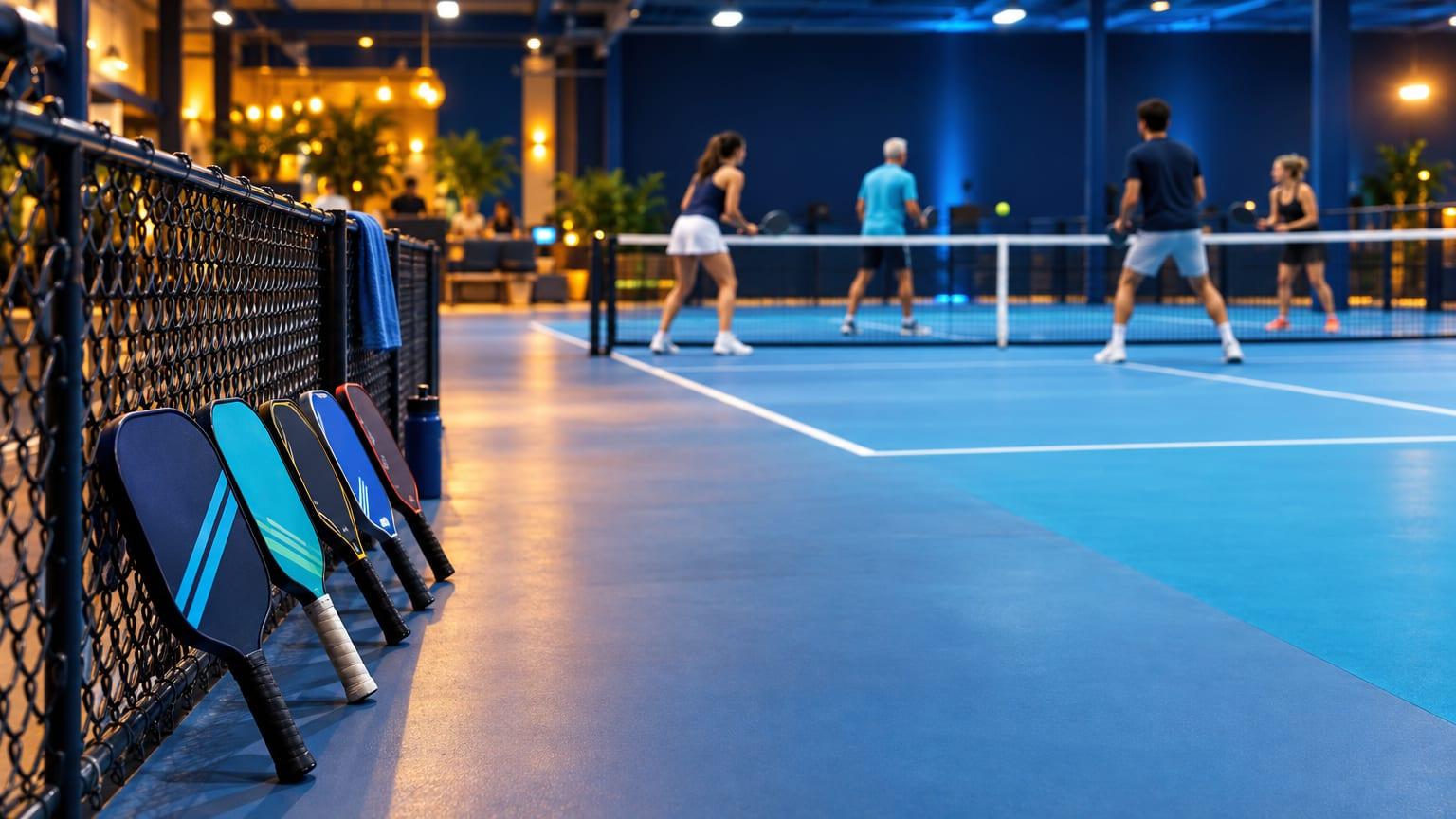
Paddle stacking. Players leave their paddles in a line, leaning against a fence or lying in a stack at the side of the court. The order of the paddles is the order of the queue. When a game finishes, the next four paddles in line take the court. If you arrive and see a row of paddles, add yours at the end. If you do not see one, ask someone, "Is there a paddle rack or a stack?" It is a normal question and people are glad to answer.
Winners stay, losers rotate. In one common format, the winning pair stays on the court and the losing pair leaves and goes to the back of the queue. Two new players come on. This keeps stronger players on the court longer and gives everyone else a turn.
Everyone rotates. In another format, all four players leave after each game, and the next four come on. This is more even, because nobody holds a court. It suits sessions with mixed levels, and many groups prefer it for that reason.
Split and mix. Some groups break up the winning pair, so one winner stays and picks a new partner from the waiting group. This format mixes partners quickly and tends to keep scores close.
Games to a set score or a set time. Some sessions play to eleven points, win by two. Others use a short time limit. When you step on, ask which one applies.
There is no single correct format. The right approach is to ask once, watch a game or two, and follow what the court already does. Do not try to introduce your preferred system to a session that has been running for years.
Two habits that help in any queue
First, do not hold a court. If your pair wins and the local custom says to rotate, rotate. Staying on because you want one more game is the fastest way to be remembered for the wrong reasons.
Second, be ready. When your paddle comes up, walk on, take a few warm-up shots with your opponents and be set to play. Nobody likes a team that wanders on after a long phone call.
Warm-ups and the first thirty seconds
When four players come on to a court, they usually take a few minutes to hit some easy shots, a short rally and a few serves, before the game starts. Keep the warm-up gentle. This is not the time to test your hardest drive. It is the time to find the pace of the ball and find out which of your opponents is left-handed.
Introduce yourself. A first name and a smile do more than anything else in open play. If you are playing with someone for the first time, ask what side they prefer. Some players like the left, some the right, and nobody minds a short conversation about it.
A good habit is to ask your opponents whether they want to warm up their serve or their return first. It is a small courtesy and it signals that you are there to play, not to win at all costs.
Calling lines and keeping the game honest
Most open play has no referee, so the players call the lines themselves. A few common-sense rules keep it fair and keep the game moving.
- Call lines on your side only. You are the best judge of balls landing near you, on your side of the net. Do not call a ball on the far side of the court that you could not see clearly.
- Give doubtful balls to your opponents. If you cannot tell whether a ball was in or out, the usual custom is to call it in. This is the single most important habit in line calling. It keeps arguments rare and gives people confidence that the game is fair.
- Call "out" or "good" clearly and early. A late call, after a point has been played, is the kind that causes friction. Make the call as soon as you see the ball land.
- If you did not see it, say so. "I didn't see it, your call" is always acceptable.
- A ball that hits the line is in. This is a rule, not a courtesy. Any part of the ball touching the line makes it good.
- Do not ask a partner to overrule your call. If you made a call in good faith, stand by it, but do not argue if an opponent politely disagrees. Replay the point if there is real doubt.
Similar principles cover other close judgments. If you touch the net, say so. If you stepped in the kitchen after a volley, say so. If your serve clipped the net cord and went in, accept the let and move on. Honest self-calls build trust faster than any compliment.
Serving and score calls
Say the score clearly before each serve, in the order your group uses. In doubles the call has three numbers: your side's score, your opponents' score and which server you are. If you are unsure, ask your partner quietly before you serve. Do not guess aloud and then argue. A short pause to confirm the score is better than a replayed point.
The pickleball rules, including serving and the kitchen, are covered in our pickleball for beginners guide, which is worth reading before your first open session.
Playing with people who are better or worse than you
Open play mixes levels, and the first time you meet someone far stronger or weaker than you can feel awkward. A little understanding makes it easy.
If you are the stronger player. Do not hit every ball as hard as you can. Rally with your opponents at a pace that gives them a chance. Aim for the middle of the court, not the corners, and do not target the weakest player on every shot. Talk with your partner: "I'll take the middle." If your partner is new, help them. Ask them where they feel strongest and set up points that suit them. Keep encouragement short and kind, such as "nice shot" or "good try."
You are also allowed to enjoy yourself at a level above your partner. Playing a few easy games with someone newer helps the whole community grow, and it is a good place to practice control.
If you are the newer player. You belong there. Everyone started somewhere. Play your own game and avoid trying to match a stronger player's power, which usually causes errors. Hit the ball back into the middle and over the net, and let your opponents make the mistakes. Ask questions between games. Most strong players like to explain what they are doing, if the question is polite and brief.
Do not apologize after every missed shot. A short "sorry" once is fine. A string of apologies makes your partner feel they have to reassure you.
If you are in between. Be generous in both directions. Be patient with the person behind you in skill and respectful to the person ahead of you.
Some sessions are organized by level. The Pickle N Pins pickleball pages list separate beginners, intermediate and advanced sessions, which are good if you want to play with people near your own level. Our guide to pickleball doubles strategy for beginners is a useful next step if you want to learn how to be more effective as a partner.
Being a good partner
In doubles, you spend ten minutes with someone you may have met five minutes ago. A few simple things make a big difference.
- Communicate. Call "mine," "yours" or "bounce it" so you do not collide or leave a ball between you. Call "switch" if you need to cross.
- Stay positive. Praise good shots, ignore errors, and never sigh or roll your eyes after your partner misses. A cheerful partner wins more games than a skilled but grumpy one.
- Do not coach unless asked. Unsolicited advice in the middle of a game feels like criticism. If your partner asks for a tip, give one short suggestion. Otherwise wait until the game is over and offer it kindly, if at all.
- Cover for your partner. If they go wide, move toward the middle. Positioning is half of doubles, and it is the part that beginners often neglect.
- Take responsibility for your own misses. Say "my fault" when it is, and mean it.
At the end of the game, meet at the net, tap paddles or offer a quick "good game" to everyone, including the opponents who beat you. It takes five seconds and it keeps the session friendly.
Safety, space and court manners
Pickleball is a small-court sport and the balls bounce in many directions. Good manners are also good safety.
- Do not walk behind an active court. Wait at the end of the court until the point finishes, and then pass quickly.
- Return stray balls politely. If a ball from another court rolls onto yours, stop play and call "ball on court" to avoid an injury. When a ball comes to you from another court, roll it gently back or hand it to someone. Do not hit it across.
- Hold your paddle safely. When you are waiting, keep your paddle down and avoid swinging it near others.
- Wear suitable shoes. Court shoes with good grip help prevent sprains. Running shoes can also work on indoor courts, but check what the venue asks for.
- Warm up your body. A few minutes of gentle movement helps prevent pulls, especially for players who have not exercised recently.
Respect the shared space. Keep bags and water bottles off the playing area and out of the way. Do not take a court someone else is clearly waiting to use.
Tone, language and the social side
A big part of open play culture is the way people speak. Keep your language friendly and clean, and remember that families and children may be sharing the building. Do not trash-talk someone you do not know. A little humor is welcome, but sarcasm often lands badly with strangers.
Learn names. Ask a new player where they are from, and welcome visitors who are in town. In a city like New Orleans, many players are visiting from out of town or have only just started, and a warm welcome often decides whether they come back.
If someone behaves badly, handle it calmly. Do not escalate on the court. If the problem is serious, tell the staff, who can step in. Most sessions have a good mix of people and few serious issues.
What to bring and what to expect locally
For open play you need a paddle, balls if the session does not supply them, water and comfortable clothing. The Pickle N Pins pickleball page says that rentals are available, or you can bring your own, and that water is allowed. If you are not sure what applies on the day, ask the staff when you arrive. It is a normal question.
Pickle N Pins is in Metairie and it is entirely indoors, so the weather does not change the session. The venue also has a full bar and a kitchen, so players can wait their turn with a drink or a meal, and there are TVs all around the bar. If you are new to the area, our guide to where to play pickleball in New Orleans compares the options across the city.
To check current open play times, look at the venue's pages and booking page, which are the only sources that stay current. A guide like this one cannot list session times without risking being wrong.
The short version
Open play works because strangers share a few habits: add your paddle to the queue, rotate when the group rotates, warm up gently, call lines honestly, play to the level of the court, and treat your partner kindly. Ask once if you are unsure, watch a game or two, and follow the local custom. If you do, you will find a game quickly and people will want to play with you again.