Padel is a doubles racquet sport played inside a fully enclosed court roughly a third the size of a tennis court, where a low-pressure ball can be played off the surrounding glass and mesh walls before it has to cross the net. It borrows its scoring almost directly from tennis and its wall rallies from squash, and the learning curve is famously short: most first-time players are keeping a rally alive within their first few minutes on court. The sport is still new to a lot of the United States, which is exactly why it gets confused with pickleball so often, even though the two only share a family resemblance. This guide covers where padel came from, how the court and equipment work, how a point and a match are actually scored, how the walls change strategy, and what a beginner should know before stepping on court for the first time.
Where padel came from, and why it is growing so fast
Padel dates to 1969, when a Mexican businessman named Enrique Corcuera wanted to build a tennis court at his home in Acapulco but did not have the space for a full one. He built a smaller court instead and enclosed it with walls so the ball would not constantly leave the property, and the game that resulted from that constraint became padel. According to the International Padel Federation's own account of the sport's history, it spread from Mexico to Spain in the mid-1970s through a friend of Corcuera's who built a similar court at a club in Marbella, and from Spain it reached Argentina soon after, where it grew into one of the most popular sports in the country.
For decades padel stayed concentrated in Spain, Argentina and a handful of other Spanish-speaking countries, played more like a national pastime than a global sport. That changed over the last ten to fifteen years, as courts spread across Italy, France, Sweden, the United Kingdom and the Gulf states, largely driven by how quickly a new player can start rallying and how well the sport works as a social, doubles-first activity. A global professional tour, Premier Padel, now runs events year-round and has helped raise the sport's profile outside the countries where it started. The United States is a comparatively late arrival: dedicated padel clubs are still uncommon in most American cities, though that is changing as more multi-sport venues add a court or two alongside pickleball and tennis.
The court: dimensions, walls, glass and mesh
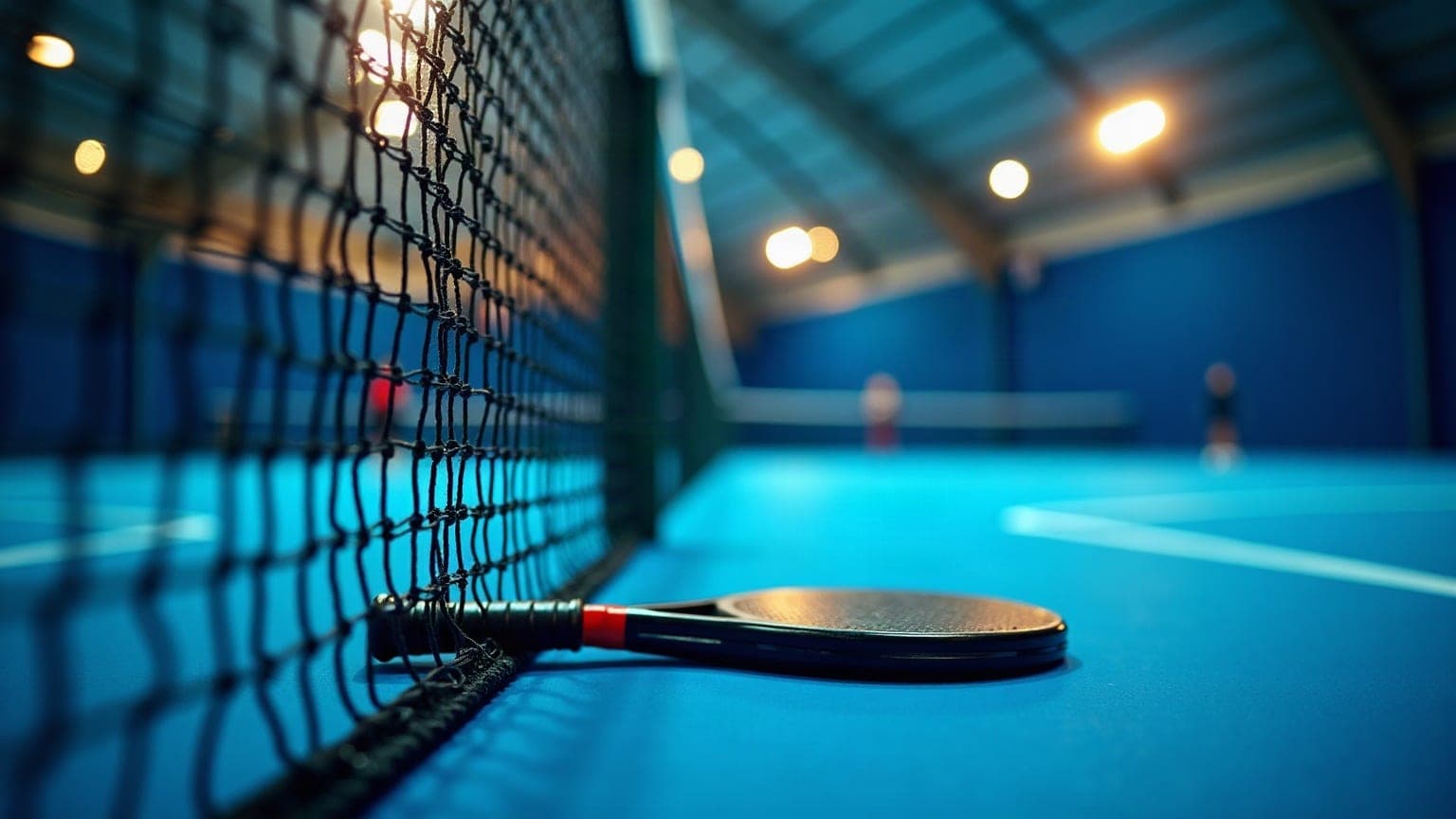
A regulation padel court measures 20 meters long by 10 meters wide, roughly a third of a tennis court, and it is completely enclosed on all four sides rather than open at the baselines the way a tennis court is. A net splits the court crosswise, similar in concept to a tennis net but strung lower, and both halves are mirror images of each other. Because the court is a fixed, walled box rather than an open rectangle, a padel court cannot be resized or improvised the way a driveway basketball hoop can; it has to be purpose-built.
What the walls are made of
The back walls, behind each baseline, are almost always solid tempered glass, typically standing about three meters high, and the side walls mix glass in the lower section with metal mesh fencing above it. That combination matters for play: the glass gives a predictable, fast bounce close to the baseline, while the mesh sections higher up the sidewalls are mostly there to contain the ball rather than to be played off cleanly. Most courts use artificial turf infilled with sand as the playing surface rather than a hard court, which slows footwork slightly compared to a tennis court and is part of why padel feels a notch more forgiving on the knees.
Equipment: the paddle and the ball
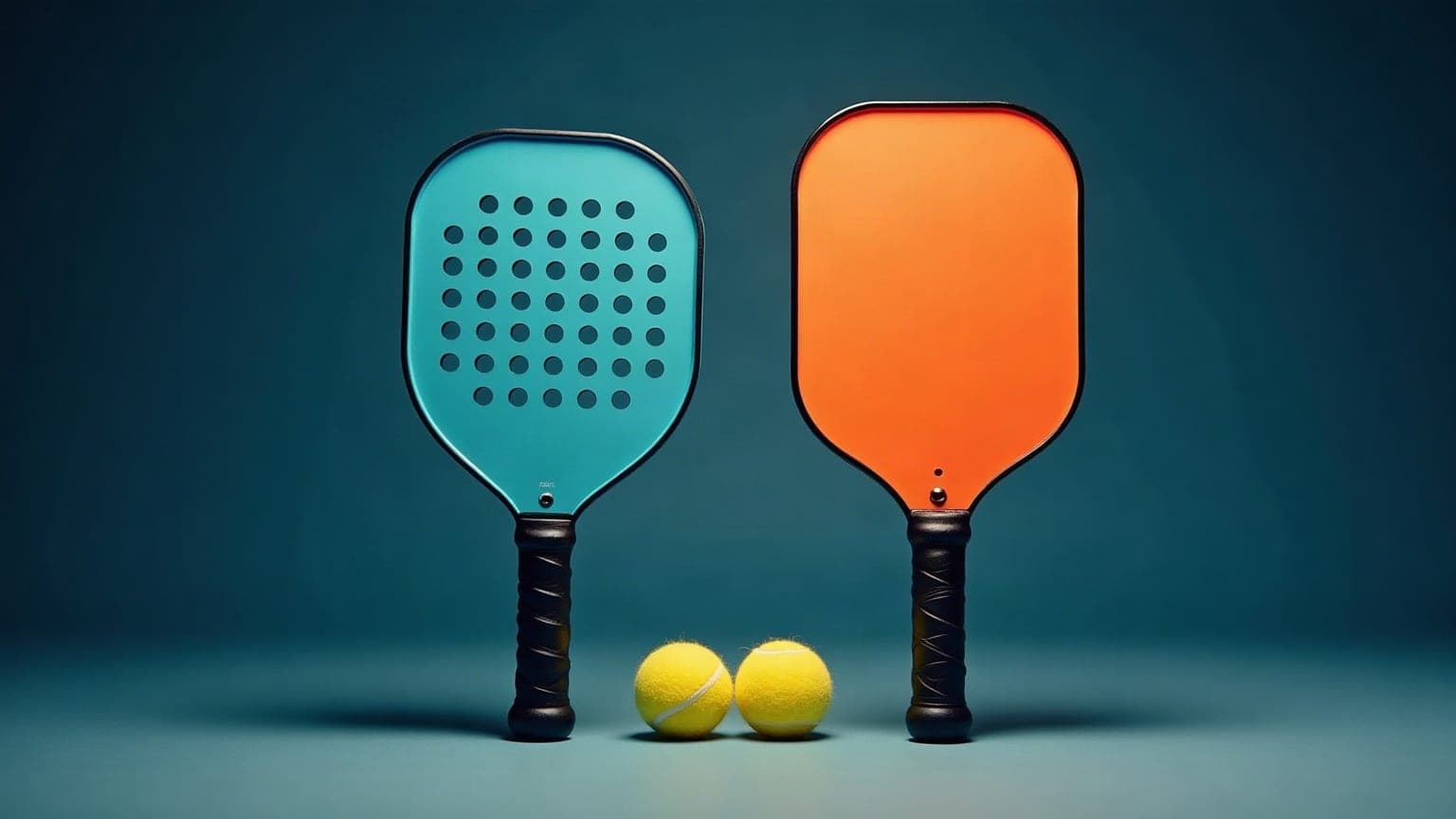
A padel paddle looks nothing like a tennis racquet up close. It is solid rather than strung, built from a foam core wrapped in fiberglass or carbon fiber, with a perforated hitting face instead of strings. Regulation paddles run up to roughly 45 centimeters long, noticeably shorter than a tennis racquet, and there is no string bed to tension, break or replace, which is one less thing to maintain compared with a tennis or badminton racquet.
The ball looks almost identical to a tennis ball at a glance but is pressurized slightly lower, so it does not bounce quite as high or travel quite as fast off the paddle. That lower bounce suits the smaller court and the wall play: a livelier, tennis-pressure ball in a space this size, bouncing off glass a few feet away, would be far harder to control. Neither the paddle nor the ball is interchangeable with tennis equipment, so a first-time player should expect to rent or buy padel-specific gear rather than bring a tennis bag.
How the walls change the way you play
The single biggest adjustment for a newcomer, especially one coming from tennis or pickleball, is that a ball is not automatically dead once it gets past you. After it bounces once on the court surface, it can carry on to hit a back or side wall and still be a live, returnable ball, much like squash, provided it bounced on the court first. That single rule reshapes almost everything about how a point is played: shots that would be clean winners on an open court become recoverable, rallies run longer, and raw pace matters less than positioning, anticipation and shot selection.
That wall play rewards a particular kind of shot. The lob, hit high and deep to push the opposing team back toward their own back glass, is one of the most common shots in padel at every level, because it buys time to reset position and can force a defensive, off-balance reply off the back wall. Smashes and overheads off a ball coming back from the glass are a staple of the sport once players get comfortable with the timing, and a lot of higher-level padel strategy is really about controlling when the ball goes to the wall and when it does not, rather than simply trying to hit harder than the other team.
Serving and the full scoring system
Padel's scoring will feel almost entirely familiar to anyone who has watched tennis, with a few differences layered on for how the serve and the walls work.
How you serve
The serve in padel is always hit underarm. The server bounces the ball once inside their own service box, then strikes it below waist height so it travels diagonally into the opposite service box, similar in shape to a tennis serve but without the option of an overhead motion. As in tennis, a server gets a first and second attempt on each point: a fault on the first serve is not the end of the point, only a chance to serve again. Serves rotate between partners and sides in a fixed pattern over the course of a game, so both players on a team serve roughly the same number of points across a match.
Scoring a game, a set and a match
Individual points follow tennis's familiar sequence: love, 15, 30, 40 and game, and a side has to win by two clear points once the score reaches 40-40, known as deuce. Many recreational venues and even some competitive formats use a "golden point" rule at deuce instead, where the next point decides the game outright rather than requiring a two-point margin, mainly to keep matches moving. Games are grouped into sets, and a set is normally won by the first team to reach six games, again by a margin of two; if the set reaches six games apiece, a tiebreak decides it. A full match is typically the best of three sets, and at the recreational level a deciding "match tiebreak" sometimes replaces a full third set to keep total playing time reasonable.
Doubles positioning, technique and common mistakes
Padel is played almost exclusively in doubles, two against two, and very little of the sport's design makes sense outside that format.
Positioning and covering the court
Each team splits the court left and right rather than front and back, and holding that split is most of what good doubles positioning comes down to: one partner covers the forehand side, the other the backhand side, and both move forward and back together rather than one staying at net while the other camps on the baseline. Because the ball can come back off any wall at an angle neither player expected, constant, short verbal communication, calling "mine," calling a ball out, calling a switch, matters more in padel than in most racquet sports.
Basic technique and the mistakes beginners make most
Because the paddle is solid and has no strings to absorb pace, a full tennis-style swing tends to send the ball flying long or into the glass with too much force; shorter, more compact strokes generally control the ball better than a big swing does. The most common mistakes for a first-time player are turning away from the ball too early after it passes them, assuming it is dead when it is actually about to come off the wall; standing too close to the back glass, which leaves no time to react to a ball coming back at them; and trying to overpower every shot instead of using a lob to reset a point that is going badly. None of these take long to correct once a player has played a few games and started reading how the wall changes a rally.
Etiquette on court
Padel etiquette borrows most of its norms from tennis: call the score before serving, be honest and quick on any line call since most recreational matches have no umpire, and never walk across a live court to retrieve a ball. A couple of habits are specific to walled courts: hold a stray ball until the player who needs it asks for it back rather than firing it across mid-point, and avoid touching the glass or mesh unnecessarily while a point is live, since it can be distracting to players on either side of it.
Padel at Pickle N Pins in Metairie
Padel is one of six ticketed activities at Pickle N Pins in Metairie, and like the rest of the building, it is played fully indoors, which takes Louisiana's heat and rain out of the decision entirely. Pickle N Pins says it was the first venue in Metairie to add padel courts, and the building also runs a full bar and kitchen on site, so a match does not have to be the whole visit; food and drinks are available before or after court time without leaving the building.
As of recent research, no other dedicated padel venue in the New Orleans metro area was confirmed as currently open and bookable: one nearby project, New Orleans Padel Club in the Warehouse District, described itself on its own site as opening soon rather than already operating, which is worth checking directly since that kind of status can change quickly. That makes Metairie a reasonable starting point for trying the sport in this part of Louisiana, though it is not a claim that will hold forever as more courts get built regionally. Courts can be reserved through booking, and current rates are on the pricing page rather than repeated here, since they are the kind of detail that changes independently of how the sport itself works.
The bottom line
Padel is a doubles racquet sport played inside a fully enclosed court, where a low-pressure ball can be played off glass and mesh walls before it has to clear the net, and it borrows its scoring almost entirely from tennis. The walls are what make it distinct from anything else most Americans have played: they extend rallies, reward positioning and anticipation over raw power, and make the sport unusually forgiving for a mixed-skill doubles group compared with an open court.
It is not the only reasonable answer to "which racquet sport should I try," and it should not be treated as one. Someone who already owns tennis or pickleball gear, or who lives somewhere without a padel court nearby, loses very little by sticking with what is already available and easy to book; pickleball in particular shares padel's low learning curve and is far more widely available across the United States right now. For anyone in or near Metairie who wants to see what the walls actually add to a match, Pickle N Pins has an indoor court and no need to wait for good weather, and the padel vs pickleball comparison is the next read if it is still not clear which of the two is the better starting point.