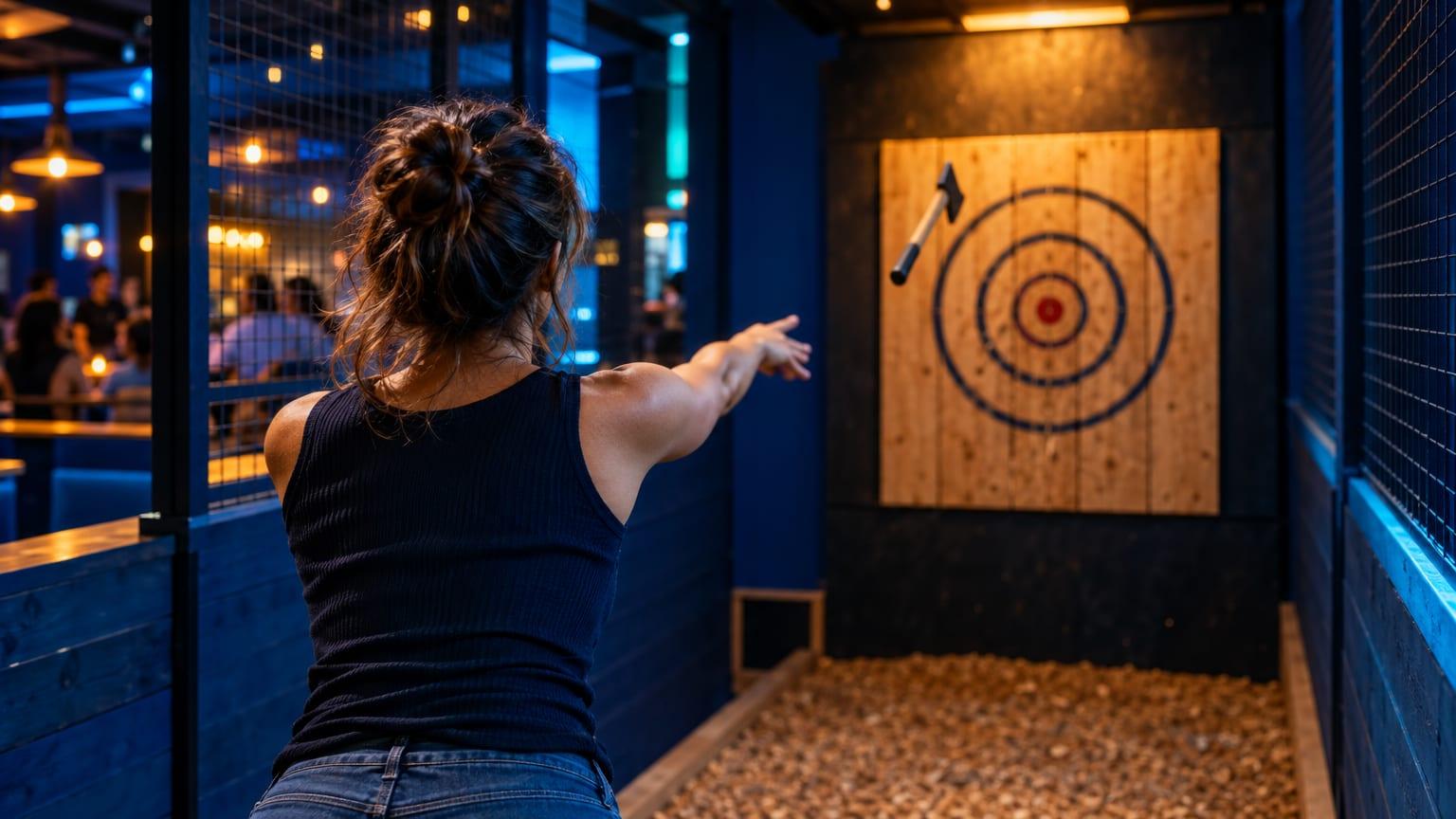

Duckpin bowling looks gentle. The ball is small, the pins are short and the lanes are the same ones you may know from ten-pin. Then the first few frames arrive, and a first-time player learns what regulars already know: knocking down all ten pins with a small, light ball is surprisingly hard. The same smallness that makes duckpin easy to pick up makes it demanding to master, and the gap between a beginner's score and a good one comes down to a few habits that can be learned in an afternoon.
This guide covers those habits. It explains how to hold the ball, how to build an approach you can repeat, where to aim, how to think about leaves and spares, and how to practice without wasting rolls. It assumes you already know the basics. If you do not, start with our what is duckpin bowling explainer, and keep our guide to bowling scoring open for the points system. The comparison in duckpin vs ten-pin bowling is also worth a read if you are coming from the bigger game.
Know what you are playing with
Good technique starts with understanding the equipment. A duckpin ball is about five inches across, has no finger holes and weighs somewhere between three and four pounds, according to the venue's own explanation of the game. The pins stand a little over nine inches tall and are squat and wide in the middle. Each frame allows three rolls instead of two.
Those facts have practical consequences.
- The ball is light, so it deflects. A heavy ten-pin ball carries momentum through the pins. A small, light ball loses energy quickly and can be knocked off line by the first pin it hits. A clean hit on the right spot matters more than raw speed.
- There are no finger holes, so grip is about control, not leverage. You cannot spin the ball by pulling your fingers out of a hole. Everything comes from how you hold it and how your hand leaves it.
- The pins are short, so there is more space around them. Pins that fall over have farther to travel before they hit another pin. That is why leaves are harder to clear than in ten-pin.
- Three rolls give you a second chance. Use the third roll deliberately, not as an afterthought. A frame is not lost until the third ball is thrown.
At many duckpin alleys, pins that have been knocked down stay on the lane between rolls in the same frame, and the ball can hit them. This is sometimes called "deadwood," and it changes how you aim your second and third rolls. How the lane in front of you handles it depends on the alley, so ask the staff how it works where you are bowling, rather than assuming.
How to hold the small ball
Because there are no finger holes, the grip is the first thing to get right. There is no single correct grip, but a few principles help.
Cradle, do not squeeze. Hold the ball with your fingers spread across the back and your thumb on the side, supported by your palm. Imagine holding a small melon. A tight grip makes the release jerky, and the ball will leave your hand early or late.
Keep your wrist firm and straight. A wrist that bends on the release is the most common cause of stray rolls. You want the ball to leave your hand with the wrist in the same position every time.
Use two hands to carry it. Hold the ball at waist height in front of you with both hands while you stand at the line. Use only your throwing hand for the swing. The second hand keeps the ball steady and relieves your arm until the last moment.
Choose a ball that suits your hand. Most alleys offer a few duckpin balls. Pick one that feels comfortable when you hold it and does not tire your arm. A heavier ball is not always better. If it makes you rush the release, choose a lighter one.
Find a release you can repeat. Many players roll the ball straight out and let it travel with little spin. Others put a slight turn on it. For a beginner, straight is the better choice, because a ball with no spin follows the line you gave it, and you can adjust your aim based on what you see. Add a hook later if you want one.
Build an approach you can repeat
The approach is the walk that carries you to the foul line. Its purpose is not style. It is to deliver the ball to the same place, at the same speed, every time. Here is a simple approach that works for most players.
- Stand with your feet together, a little behind the line. Keep a small distance so you do not cross the line by accident.
- Hold the ball at waist height, in front of you. Square your shoulders to the pins.
- Take three or four short steps. Start with the foot opposite your throwing hand. Short steps are more controlled than long ones and make it easier to stop at the same spot each time.
- Swing the ball back and forward in a smooth arc. Let gravity do most of the work. Do not force the swing.
- Release the ball low and smooth, close to the lane. Dropping it from a height causes bounce and loss of direction. Aim to let go just after your hand passes your ankle.
- Follow through toward your target. Your throwing hand should finish pointing at the pins, as if you were shaking hands with them.
- Hold your finish for a second. If you wobble or step across the line, the delivery was not balanced.
Consistency beats speed. A slower, steady roll that arrives where you intended is better than a fast one that wanders. Most beginners improve their scores more by slowing down than by throwing harder.
Watch your foot position. Most lanes have a foul line, and crossing it costs you the roll. Stop a few inches short at first, until you know where your steps carry you.
Aim at a target, not at the pins
Staring at the pins is a natural instinct and a poor one. Pins are far away and numerous, and your eye jumps between them. Instead, pick a point close to you and roll the ball over it.
Many lanes have small arrows or dots embedded in the wood a few feet beyond the foul line. These are aiming marks, and the staff can tell you whether yours has them. Choose one, say the center mark, and aim to roll the ball directly over it. Because the mark is close, small errors in your swing are easy to see and correct. Pins that are sixty feet away hide the same errors.
Here is a practical way to use them.
- Start with the center mark. Roll a few balls over it and see what happens. If the ball tends to drift to the left, move your starting position slightly to the right, or the other way round.
- Change one thing at a time. If you move both your feet and your target, you will not know which change helped.
- Aim for the front pin, or just beside it. The front pin, the one at the point of the triangle, is the entry. In ten-pin bowling, players often aim for the "pocket," the space between the front pin and the one behind it. In duckpin, a ball that hits the front pin squarely sends it back into the others, and a ball that hits slightly to one side gives a good scatter. Try a few lines and see which gives the cleaner result on your lane.
- Trust the line. If you have picked a good mark and rolled over it, let the result happen. Do not try to steer the ball after it has left your hand.
Speed and ball path
New players often assume that more speed means more pins. In duckpin, it often means fewer. A very fast ball can bounce off the pins and scatter in directions that leave awkward gaps. A medium-speed ball loses less energy and tends to send pins into each other more effectively.
Find a speed that feels comfortable and repeat it. Many players settle on something close to a firm toss, not a hard throw. If the ball is skidding or bouncing on the lane, you are probably releasing it too high or too forcefully. Let the ball roll rather than fly.
The path of the ball also matters. A ball that travels straight down the lane, with no curve, gives you the clearest information. If it goes where you aimed and the pins do not fall, the problem is the angle of contact. If it does not go where you aimed, the problem is your delivery. Knowing which problem you have is half the fix.
Reading the leave and playing the spare
Rarely will a roll clear all ten pins. Strikes in duckpin are rare, and most frames come down to what you do after the first roll. The pins still standing are called the leave, and how you handle the leave decides the frame.
Use all three rolls with a plan
Think of the frame as three chances to knock down ten pins in total. The first roll should aim to knock down as many as possible, leaving a manageable group. The second roll should aim to reduce the leave to a few pins or a single pin. The third roll finishes the job. A frame that takes all three rolls scores the pins you knocked down and no bonus. A frame that clears the pins in two rolls is a spare and earns a bonus. A frame that clears them in one roll is a strike and earns a bigger one. The scoring details are in our scoring guide, which explains how bonuses are calculated, and our duckpin explainer covers how the third roll changes the picture.
Approaching the spare
When pins remain, change your aim to suit the leave. A few rules help.
- For pins on one side, move your starting position to the other side. To hit pins on the left, stand a little to the right and roll across at an angle. This increases the area you can hit and reduces the chance of rolling straight past.
- For a single pin, aim directly at it. Take your time. A single pin is a small target, and a smooth, steady roll is more likely to hit it than a rushed one.
- For pins that are far apart, aim to hit one and let it bounce into the other. Duckpin leaves with wide gaps are often impossible to clear in one roll, so use the second roll to take one pin and the third to take the other.
- Do not chase everything. If a leave is awkward, aim to knock down as many pins as you can, so the third roll has a simpler task.
Watch where your ball goes, and adjust. If you missed a spare on the left by an inch, move an inch the other way for the next try. Because the ball is light, very small changes matter.
Mind the deadwood
If the alley leaves fallen pins on the lane between rolls, treat them as obstacles. A ball that hits a fallen pin can be deflected. Aim so the ball travels along a clean path to the remaining pins. If the rules of the alley allow you to ask for the lane to be cleared, ask. If they do not, plan the angle of your roll so the ball avoids the pins that have already gone down. Ask the staff how it works at your lane.
Mental habits that help
Bowling is a game of repetition, and the mental side matters as much as the physical.
Use a routine. Take the same few seconds before every roll: breathe, pick your target, visualize the line, and go. A routine reduces nerves and keeps your delivery consistent.
Forget the last roll. A bad roll has already happened. Treat each ball as a new attempt. Players who dwell on mistakes make more of them.
Celebrate small gains. Duckpin scores tend to run lower than ten-pin scores. Do not measure yourself against ten-pin numbers. A fair comparison is your own average from last week.
Stay relaxed. Tension in the shoulders and neck makes the swing jerky. Shake out your arms between turns and keep your breathing steady.
Enjoy the group. Duckpin is a social game, and the people around you affect your own play. If you are with friends or family, laugh at the odd leave and cheer for the lucky bounce.
How to practice
You do not need many hours to improve. A few focused sessions help more than a long unfocused one.
- Roll ten balls at the same mark. Ignore the pins. Watch where the ball crosses the mark and where it ends. This is the best way to find out how steady your release is.
- Practice a single-pin spare. Set up a leave, if the alley allows it, or simply aim at one side of the lane. Roll five balls at the same corner pin and see how many connect.
- Try a slower speed, then a faster one. Compare the results and choose the speed that gives you the most pins.
- Record your scores. Write down your game totals and the number of spares. A simple record shows whether you are improving.
- Play with better players. Watching a strong player is the quickest way to see good technique. Ask them what they aim at.
Where to play and what to expect locally
Pickle N Pins in Metairie has duckpin lanes indoors, with a full bar and kitchen on the premises. The duckpin bowling page describes the lanes as suited to all ages and skill levels, and says they work well for groups and events. Because the lanes are indoors, a rainy day makes no difference. For rates, which change, always use the pricing page. The activities page lists everything else on offer if your group wants to mix duckpin with something else, and our guide to group outing ideas in New Orleans shows how to build an evening around it.
The staff at any alley are a useful resource. Ask them how the lane handles fallen pins, whether there are aiming marks and which ball suits you. They see hundreds of rolls a week and can often spot a small fix.
The short version
To score higher at duckpin: hold the ball with a relaxed, steady grip and a firm wrist, use a short and repeatable approach, aim at a mark a few feet ahead instead of the pins, roll at a medium pace and release low. Use all three rolls in a frame with a plan, move your starting position to match the leave, and keep your attention on the next ball, not the last one. Then keep a record, practice a little and enjoy the game. The scores will follow.