
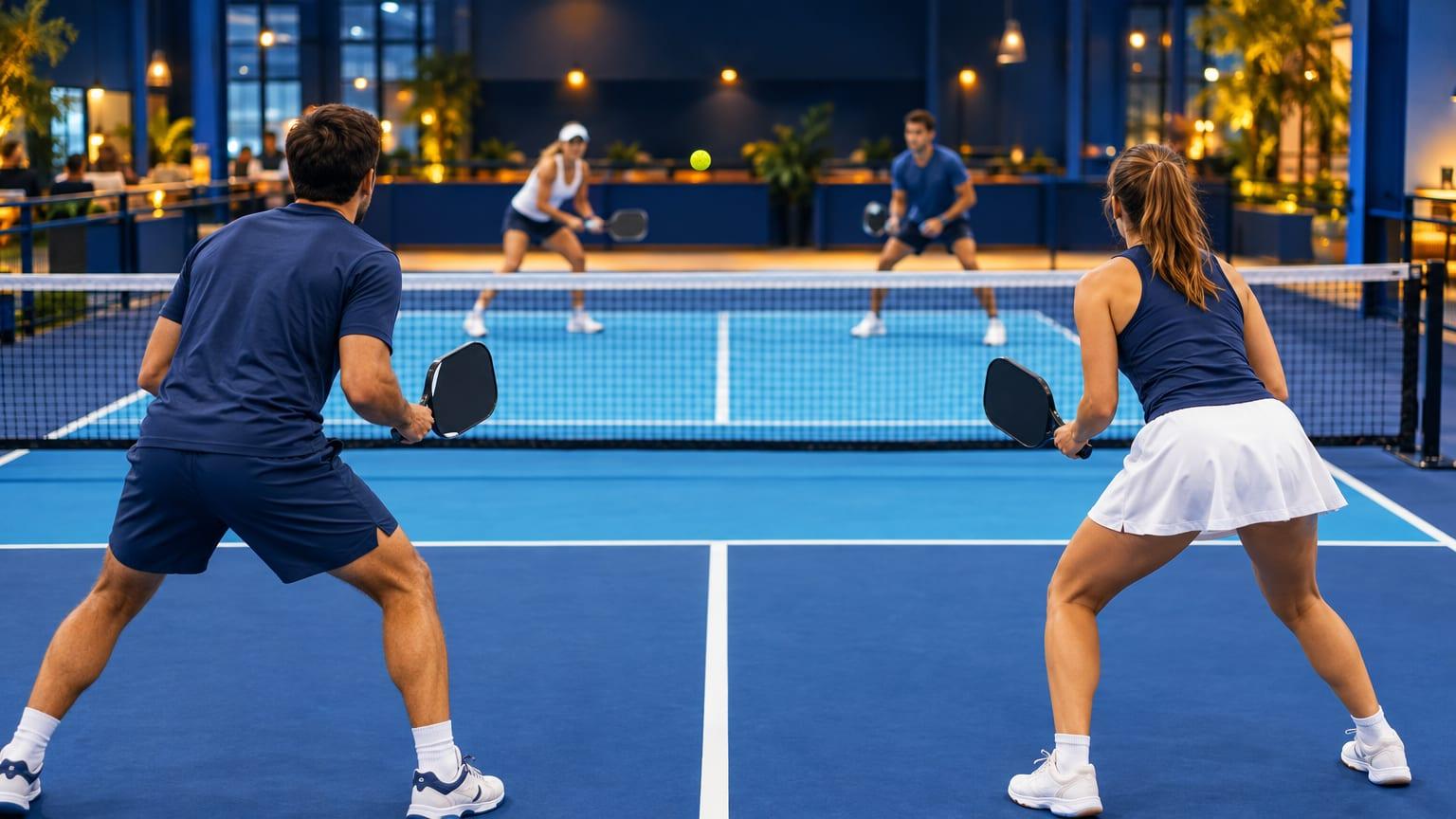
The rules of pickleball fit on a few pages, and the ones that decide most points fit in a few sentences. You serve underhand and diagonally. The ball has to bounce once on each side before anyone volleys. Nobody volleys from inside the zone next to the net. Only the serving side scores, and a game goes to 11 points, won by two. Everything else is detail on those four ideas, and the detail is what this guide covers.
Pickleball for Beginners gives the wider picture of the sport, what to bring and what a first session feels like. This guide goes deeper on one narrower job: the rulebook itself, in the order you meet it during a game. Serve, return, the two-bounce rule, the kitchen, the faults that end a rally, and the part that confuses almost every first-timer, which is calling the score out loud in doubles. None of it is specific to one venue. These are the standard rules used at recreation centers, clubs and indoor courts everywhere, from a park in Jefferson Parish to a tournament hall.
One caution before the detail. Rule sets get small revisions from time to time, and a league or a tournament can change a few points, such as the winning score or the way a ball that clips the net on a serve is treated. For a casual game with friends the standard rules below are the safe default. For an organized event, read the event's own rules page once before the first match.
The court and the equipment in one minute
A pickleball court measures 20 feet wide and 44 feet long, the same footprint as a doubles badminton court and a little under a third of the area of a tennis court. The net sits at 36 inches at the posts and dips to 34 inches in the center. Each side has a rectangle running 7 feet out from the net, and that rectangle is the non-volley zone, better known as the kitchen. Behind it, the court splits down the middle into a left and a right service court, and those two boxes are where every serve has to land.
The lines matter because a ball that touches a line is in. That is true of every line except the kitchen line on a serve, which belongs to the kitchen and counts as short. Keep that single exception in mind and line calls get much simpler.
You need two things to play: a solid paddle and a perforated plastic ball. The paddle is not strung like a tennis racquet, and the ball is closer to a wiffle ball than to anything used in tennis. If you do not own a paddle yet, How to Choose a Pickleball Paddle explains what the differences in weight and shape actually do. Pickle N Pins says on its pickleball page that paddle and ball rentals are available, or you can bring your own, so a first game does not need a purchase.
How a serve works
Every point starts with a serve, and the serve has more rules than any other shot. Learn these six and nobody can fault you on the first ball of the game.
- The serve is underhand. The paddle swings upward, and you strike the ball at about waist level or below, with the paddle head kept below your wrist. The rulebook sets the exact heights, and the practical meaning is simple: no overhead smashes, ever.
- You can serve out of the air, called a volley serve, or you can drop the ball and let it bounce first, called a drop serve. Both are legal in the standard rules, and a drop serve is the more forgiving choice for a beginner because you do not have to worry about contact height.
- The ball must travel diagonally across the net and land in the service court on the far side, opposite the one you are standing behind.
- It has to clear the kitchen entirely. A serve that lands on the kitchen line is short and counts as a fault.
- At the moment you hit it, at least one foot must be behind the baseline, and neither foot may touch the baseline or the court inside it. Your feet also have to stay inside the imaginary extension of the sideline and center line.
- You get one attempt. Unlike tennis, there is no second serve, so a missed serve ends your turn to serve.
That last rule surprises people who have played other racquet sports. In pickleball a fault on the serve is a real cost, not a free retry, and it is why most beginners pick a gentle, deep, high-percentage serve instead of anything flashy. A ball that clips the net on a serve and still lands in the correct service court is treated under current standard rules as a normal serve and is played on, though some leagues keep an older rule that replays it, so check when you join an organized session.
Partners are free to stand wherever they like on their own side of the net, even right up at the kitchen line, as long as they are outside the kitchen when they volley.
The two-bounce rule
The two-bounce rule is the single rule that shapes the strategy of the game, and it is easy to state. After the serve, the ball has to bounce once on the receiving side before the receiver hits it. Then the ball has to bounce once on the serving side before the server's team hits it. Only after those two bounces can anyone volley, which means hit the ball out of the air without letting it bounce.
Here is the sequence in a plain list, because a diagram on a page is hard to picture and a list is not.
- The server hits the serve. It lands in the diagonal service court.
- The receiver lets it bounce, then returns it.
- The server's side lets that return bounce, then hits the third shot.
- From the fourth shot onward, anyone may volley or play the ball after a bounce.
The reason for the rule is that it prevents the serving team from rushing the net and ending the point before the receiver has done anything. It slows the start of every rally and gives the receiving team time to move forward too. A common beginner fault is hitting the return of serve out of the air by habit, particularly when the receiver's partner is standing close to the net. The shot has to bounce first. For how the best players use the rule once they understand it, Pickleball Doubles Strategy for Beginners covers the third-shot drop and why teams work to reach the net.
The kitchen, or non-volley zone
The kitchen is the 7-foot strip on each side of the net, and its rule is the one that new players break most often. You may not volley the ball while you are standing inside the kitchen or touching any part of its lines. A volley made from outside it is fine, and so is a bounced ball played from inside it.
Three details trip people up repeatedly.
- Momentum counts. If you volley a ball from outside the kitchen and your momentum carries you into the kitchen or onto its line afterward, it is still a fault, even if the ball was already out of play when your foot came down.
- Your gear counts. If your paddle, your hat or your clothing touches the kitchen while you are volleying, that is a fault too.
- You may stand in the kitchen any time the ball is not being volleyed. The rule does not ban the zone. It bans volleying from it, so you can step in to play a ball that bounced there, and you can stand in it while a rally goes on elsewhere, provided you are not about to volley.
The reason for the zone is to keep the game from becoming a contest of net-hugging smashes. Because players cannot camp at the net and slam every ball, rallies include soft shots called dinks, which land inside the opponents' kitchen, and the sport rewards placement over raw power. If you are new to it, treat the kitchen line like a wall for volleys. Stay behind it until you are sure the ball will bounce, and you will almost never fault there.
Faults: what ends a rally
A fault ends the rally. On your serving turn a fault costs you the serve, and on a receiving turn it gives the serving side a point. The list is longer than most people expect on day one, so here it is grouped by cause.
Ball faults
- The ball lands outside the court, which means beyond a boundary line. A ball that touches the line is in.
- The ball hits the net and does not clear it. On a serve, the exception above applies.
- The ball bounces twice on your side before you hit it.
- You hit the ball into the net. A ball that goes around the net post and lands in the court is legal, which surprises some beginners.
Contact faults
- You volley before the ball has bounced once on each side after the serve, which is the two-bounce rule again.
- The ball hits any part of your body or clothing, or your partner, before it bounces. The hand holding the paddle counts as part of the paddle, so a ball that strikes it is a legal hit.
- You hit the ball twice in a row in two separate motions. A double hit is legal only when it is a single continuous swing in one direction.
- You catch or carry the ball on the paddle rather than striking it cleanly.
Position and serve faults
- You volley from inside the kitchen or on its lines, including by momentum.
- You step on or over the baseline during a serve, or serve from the wrong side or out of turn.
- Your serve is not underhand or is struck above the allowed height.
- You reach over the net to hit a ball before it crosses to your side. You may follow through over the net, but contact has to happen on your own side.
If there is a dispute, the rule on line calls is simple: you call the ball on your own side of the net, since you have the best view. When you cannot tell whether a ball was in or out, you give your opponents the benefit of the doubt and call it in. It keeps games friendly, and it is how the sport is played at casual sessions everywhere.
Scoring and calling the score in doubles
This is the part that looks hard in print and turns out to be easy after about three points. The rules below describe the standard side-out scoring used in most recreational play.
Only the serving side can score. If the serving side wins the rally, it gets a point and the same player serves again from the opposite side of the court. If the receiving side wins the rally, it gets no point but gains the serve. That is called a side-out. A game goes to 11 points and must be won by two, so a score of 11 to 10 is not over and play continues until a side leads by two.
In doubles, each side has two servers, and both of them serve before the serve passes to the opponents. A side keeps the serve until each of its two players has faulted once. There is one exception, and it is at the very start of the game: the first serving side gets only one server, so the opening serve passes to the other side after a single fault.
The three-number call
Before every serve, the server says three numbers aloud, in this order.
- The serving side's score.
- The receiving side's score.
- Which server the serving player is, one or two.
So the game begins with the call "zero, zero, two." The server is the second server because the first side gets one serve only, and the call tells everybody the serve will pass over after that one fault. Suppose the serving side wins the first rally. The call becomes "one, zero, two," and the same player serves again. Say that side then loses a rally. The serve passes to the other side, which calls "zero, one, one": its own score first, then the opponents' score, and server number one because this is the first serve of its turn.
Two practical rules keep everyone in the right place.
- Even score, right side. The serving side serves from the right court when its own score is even and from the left court when its score is odd. If you are ever unsure where to stand, check your side's score.
- Switch sides only after scoring. The serving side's two players trade positions each time their side wins a point on serve. The receiving side's players do not move. After a side-out, players stay where they are, and the new serving team serves from whichever court its own score dictates.
Many groups write the three numbers on a napkin for the first game, and there is nothing wrong with that. After a game or two you will say the call without thinking, and you will notice it is also useful for another reason, which is that it settles every argument about whose serve it is.
Singles
Singles scoring uses the same side-out system with a two-number call: the server's score first, then the receiver's. The server serves from the right when the server's score is even and from the left when it is odd, and there is no second server, so a fault passes the serve to the opponent immediately.
Rally scoring
Some leagues, events and clinics use rally scoring, where either side can score on every rally, whether it served or not. Games are usually to a higher number, often 21, and the call is shorter. It is quicker to follow and keeps a session on schedule. If you are playing in a league, ask which system it uses, because the three-number call belongs to side-out scoring.
A few etiquette habits that go with the rules
The rulebook does not tell you how to behave, but a few habits show up at every court and make a session pleasant.
- Say the score clearly before each serve, and wait for the receiving side to be ready.
- Call your own faults when you know about them, such as a foot in the kitchen, without waiting for someone to argue.
- If a ball from another court rolls onto yours mid-point, call "ball on court" so players can stop and avoid a turned ankle.
- Return stray balls politely, and thank the other court for returning yours.
These small courtesies are why pickleball is known as a social game. They also make learning easier, since an honest and friendly table is one where you can ask a question mid-game without anyone minding.
Learning the rules in Metairie
Rules are easier to absorb on court than on a page, and a game is the fastest way to turn this guide into habit. Pickle N Pins has indoor pickleball courts in Metairie, with court rentals booked by the hour, open play, lessons and clinics. The beginners session page describes a Monday evening session for brand-new players that covers the rules and scoring, grip and footwork, serving, and court etiquette, with equipment provided on site. Check that page for the current time and booking, since sessions can change.
If you would rather play with your own group first, Where to Play Pickleball Near New Orleans compares the indoor options around the area, and Pickleball Cost Near New Orleans walks through what a session costs. For the current rates at Pickle N Pins, the pricing page is always the source to trust.
The short version to take on court
If you remember nothing else, remember these seven lines.
- Serve underhand, diagonally, and clear the kitchen. You get one try.
- Let the serve bounce. Let the return bounce. After that, volleys are fine.
- Never volley while standing in the kitchen or on its line.
- A ball on the line is in, except a serve on the kitchen line.
- Only the serving side scores, to 11, win by 2.
- In doubles, call three numbers: your score, their score, server one or two.
- Even score means serve from the right. Switch sides only after you score.
Play one game with those seven lines in your pocket and the rulebook stops feeling like a rulebook. It starts feeling like a game with a rhythm, and the rhythm is why the sport keeps drawing people back to the court.