
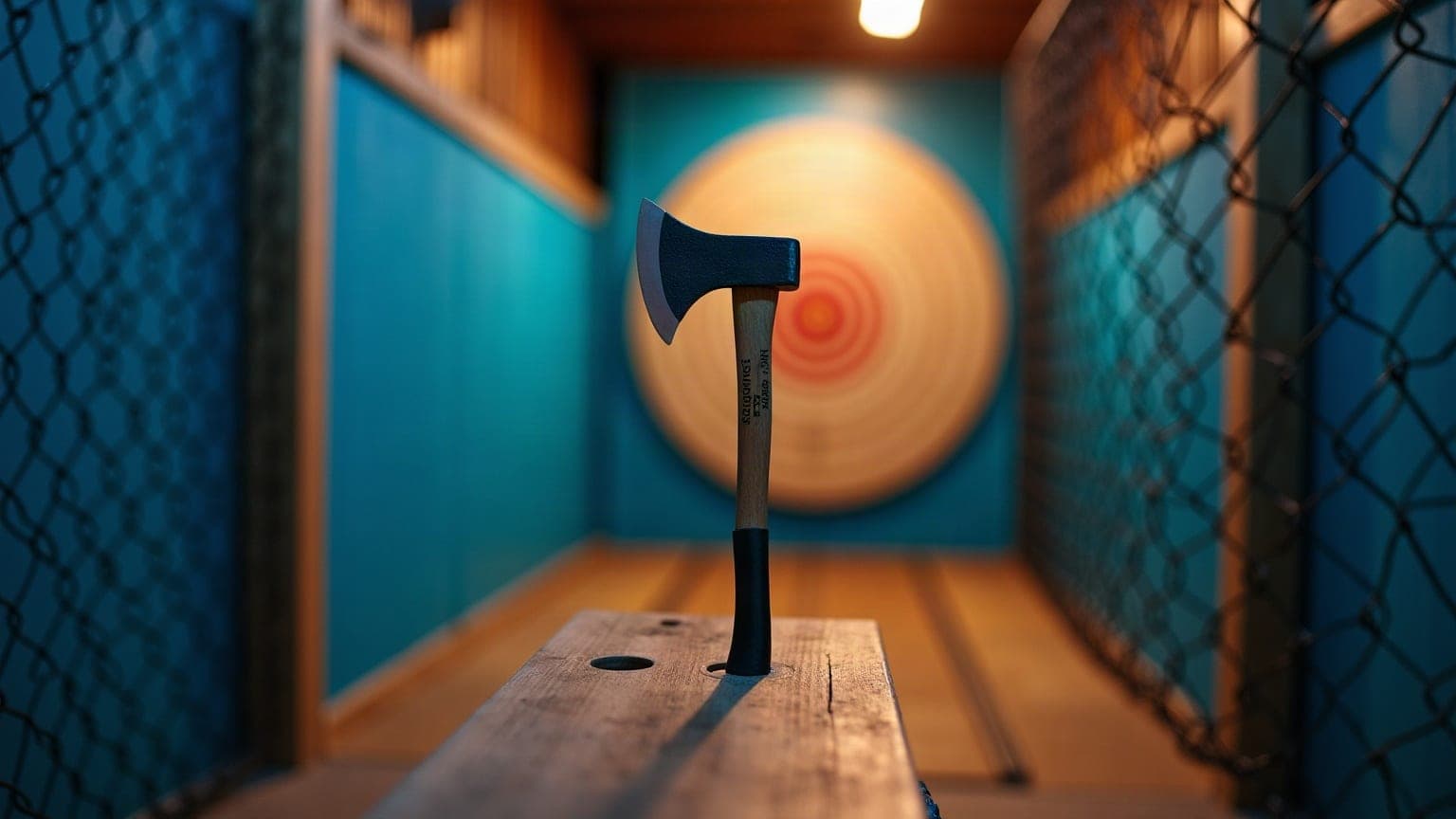
Axe throwing is a target sport in which a thrower releases a hatchet, rotating end over end through the air, at a wooden board from a fixed distance, scoring points based on how close the blade sticks to the center. It has grown from a rural lumberjack pastime into an organized recreational activity with standardized lanes, supervised safety rules and beginner-friendly formats, which is why venues from big-city entertainment centers to a neighborhood spot like Pickle N Pins in Metairie can teach it to a first-timer in a few minutes with zero experience required.
Where axe throwing comes from
Throwing an axe at a target has roots in old lumberjack and timber-sport competitions, where chopping, sawing and throwing contests were a way for logging crews to show off skill during slow stretches and at county fairs. Those events, sometimes grouped under the banner of "timbersports," kept axe throwing alive as a niche competitive sport for most of the twentieth century, mostly outdoors and mostly tied to logging culture rather than to anyone who had never held an axe.
The recreational version most people know today traces to a backyard gathering in Toronto in the mid-2000s, where a small group built a simple wooden target, added basic rules for who could step up and when, and found that the activity worked just as well for a group of friends with no woodsman background as it did for a logging crew. That gathering grew into the Backyard Axe Throwing League, one of the first organizations to move axe throwing indoors, formalize a throwing lane, and treat safety and turn-taking as part of the format rather than an afterthought.
From there, the activity spread quickly across North America through both franchised venues and independent operators, and organizations such as the World Axe Throwing League emerged to publish standardized rules, distances and scoring so that a lane in one city would look and play the same as a lane in another. That standardization is why the sport looks so consistent today: a roughly 12-foot throwing distance, a round or octagonal wooden target, and a similar set of scoring rings, whether you're at a dedicated axe-throwing franchise or an activity inside a larger entertainment venue.
The equipment: axe and target
A recreational throwing axe is not the same tool as a splitting axe or a felling axe. It's a single-bladed hatchet, typically weighing somewhere around a pound and a half to two pounds, with a wood or composite handle usually 14 to 16 inches long — short enough to control one-handed or two-handed, and light enough that a beginner isn't fighting the tool's weight through the swing. The blade is kept sharp enough to bite into wood but the tool is built for sticking into a target repeatedly, not for chopping, so it's a purpose-built piece of equipment rather than something borrowed from a woodshed.
The target itself is a round or octagonal board built from a softer wood, often pine or a similar softwood, because the wood needs to be soft enough for a swung blade to sink in rather than bounce off, and because a target absorbs damage over hundreds of throws and gets replaced on a regular schedule as it wears out. Targets are mounted inside a wooden lane or cage structure that contains the target on the sides and behind it, so a throw that misses the board entirely doesn't leave the lane. That enclosed lane design, as much as the target itself, is what makes it possible to run axe throwing as an indoor activity next to other things happening in the same building.
Throwing technique: one-handed and two-handed
Nearly every venue teaches the same two throwing styles, and most beginners start with one before trying the other.
The two-handed overhead throw
This is the default starting technique almost everywhere. Grip the axe near the bottom of the handle with both hands, raise it straight overhead so the blade points up and back, and bring it forward in one continuous motion, releasing when your arms reach roughly eye level so the axe leaves your hands pointed at the target rather than veering off to one side. The two-handed grip gives a beginner more control over where the axe points at release, which is usually the single biggest factor in whether an early throw lands anywhere near the target at all.
The one-handed throw
Once the overhead motion feels natural, many throwers move to a one-handed style, gripping the axe further up the handle and throwing more like an overhand pitch than a two-handed heave. It trades some of the raw power of a two-handed throw for a throwing motion that's easier to repeat consistently once it's learned, and it's the style most competitive throwers eventually settle into. Neither style is "correct" on its own; the one that produces a consistent, repeatable release for a given thrower is the better one for that person.
Distance, rotation and why scoring rewards the center
The throwing line in organized recreational axe throwing sits 12 feet from the face of the target, a distance used by the World Axe Throwing League's published rules and followed by most recreational venues, sanctioned or not. That distance isn't arbitrary: it's set to match roughly one full rotation of a hatchet thrown overhand at a typical release speed, which is why the axe should be arriving blade-first rather than handle-first when it reaches the board.
Why rotation matters more than power
Because the axe has to complete a specific rotation to land blade-first, throwing harder from the same spot usually makes a beginner's accuracy worse, not better, since more force changes the rotation speed without changing the distance it has to travel. A steady, repeatable release from a fixed stance does far more for a first-timer's results than raw arm strength, which is part of why the sport doesn't reward athleticism the way many other target and lawn games do.
Reading the target
Standard wooden targets are divided into concentric scoring rings, with points increasing toward the center bullseye, and many formats add one or two small bonus targets in the upper corners of the board worth extra points, often used to settle a tie between close scores. Early on, the more useful goal is landing the axe so it sticks cleanly anywhere on the board, rather than the center specifically; a thrower who can consistently stick an axe will start finding the center naturally once the throwing motion stops requiring conscious thought.
Safety rules and etiquette
Axe throwing involves a bladed tool moving through the air toward a shared space, so every venue builds its format around a small set of rules that control exactly when someone is near the target and when they're allowed to throw.
The core safety rules
Throw only when the lane and the area around the target are clearly clear of people, wait for a staff signal or a clear all-clear before walking up to retrieve an axe from the board, and stay behind the marked throwing line at all times, even between turns. These three rules cover the overwhelming majority of what keeps an axe-throwing lane safe, and a supervised venue will walk a first-timer through all three before handing over an axe.
Etiquette that keeps a lane running smoothly
Beyond the safety rules, a few etiquette habits make a shared lane more pleasant for everyone: retrieve your own axe promptly once it's your turn to do so rather than leaving it in the board, avoid celebrating in a way that crowds the throwing line while someone else is mid-throw, and hand an axe back handle-first if you're passing it to another thrower. None of this is complicated, but a group that's new to the activity together tends to have a smoother session when everyone picks up these habits in the first few throws rather than learning them by trial and error.
Common beginner mistakes to unlearn early
A handful of habits show up in nearly every first-time thrower, and most are easy to fix once you notice them.
- Gripping the handle too tightly. A relaxed grip through the swing produces a smoother, more consistent rotation than gripping the handle as hard as possible; a death grip tends to throw off the release point.
- Aiming instead of committing to the motion. Staring hard at the center of the target does less for accuracy than a consistent stance and a repeatable release; footwork and a smooth motion matter more than visual focus.
- Overhauling the whole throw after one miss. Changing the grip, the stance and the release all at once after a bad throw makes it hard to tell what actually helped; adjusting one thing at a time is easier to judge.
- Rushing up to the target. Walking up before a clear signal is one of the most common safety lapses among first-timers, usually out of simple excitement rather than carelessness, which is exactly why supervised venues insist on waiting for a signal every time.
- Throwing harder after a miss. Since rotation, not force, determines whether the axe sticks blade-first, adding power after a miss usually makes the next throw worse rather than better.
Axe throwing at Pickle N Pins
Pickle N Pins in Metairie runs axe throwing as one of six ticketed, fully indoor activities on site, alongside pickleball, padel, duckpin bowling, darts and shuffleboard, with a full bar and kitchen in the same building. Throwers must be at least 12 years old and wear closed-toe shoes, and the lane is supervised throughout a visit, so a group with no prior experience can walk in and be throwing within a few minutes. Current rates are on the pricing page, and a lane can be reserved ahead of time through booking.
For groups, axe throwing tends to work well specifically because a consistent release matters more than strength or prior experience, which keeps people of very different skill levels competitive with each other. That makes it a natural fit for a birthday party or a corporate outing where not everyone in the group has thrown before, and it pairs easily with a round of darts or duckpin bowling in the same visit for a group that wants to try more than one activity.
Locally, confirmed axe-throwing options are limited: GameOn Social Hub in Kenner is the only other currently active axe-throwing venue in the immediate area, and it sets its minimum age at 18, compared with the 12-and-up policy at Pickle N Pins. A second brand, Stumpy's Hatchet House, previously operated an axe-throwing location in New Orleans but appears to have closed as of recent research, though that kind of status can change, so it's worth a direct check before planning a visit around it.
The bottom line
Axe throwing is a target sport built around a controlled overhead or one-handed release, a fixed 12-foot distance, and a scoring system that rewards consistency over power, and it's genuinely safe and approachable for a first-timer under normal supervised rules. None of that depends on any one venue; the technique, the safety habits and the common mistakes above apply whether you're throwing at a dedicated axe-throwing franchise, a county fair booth, or a lane tucked inside a larger entertainment venue.
If the goal for the day is axe throwing and nothing else, in a highly competitive, tournament-style setting, a dedicated axe-throwing specialist elsewhere may be the better fit. If the goal is an evening where axe throwing is one part of a longer visit with other activities, food and a group that wants to split up and regroup, Pickle N Pins in Metairie is built around exactly that kind of visit, and booking a lane ahead of time is the easiest way to lock in a time slot on a busy evening.