Padel and pickleball are both fast-growing, doubles-friendly racquet sports played on courts smaller than a tennis court, and both are commonly described as easy for a beginner to pick up in a single session. Beyond that starting point, they are genuinely different games: padel is played inside a fully enclosed, walled court with a stringless paddle and tennis-style scoring, while pickleball is played on an open court with a perforated plastic ball, its own non-volley zone rule, and its own scoring system.
The court
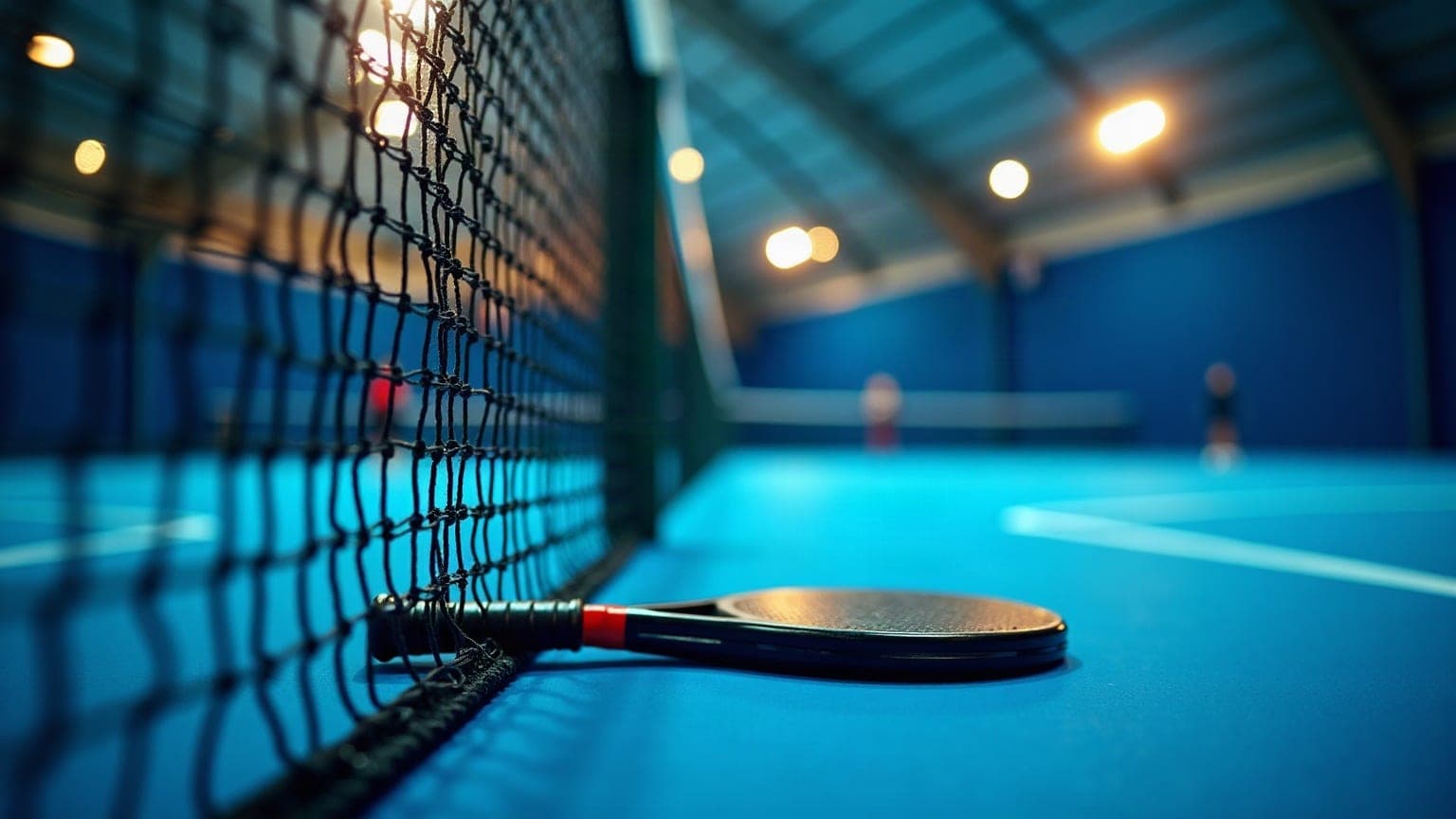
A padel court measures 20 meters by 10 meters and is completely enclosed by glass and mesh walls that stay in play, so the ball is not automatically dead just because a player's shot bounces off a wall rather than landing cleanly inside the lines. That enclosure is the single biggest structural difference between the two sports, and it changes almost everything else about how a point is won.
A pickleball court has no walls at all. It is roughly the size of a doubles badminton court, smaller still than a padel court, and any ball that lands outside its painted lines is simply out of play, the same way it would be in tennis. Because there is nothing to bounce a mishit shot back into play, a pickleball rally ends the moment the ball goes out or into the net, which tends to make points shorter and more decisive than a padel rally where the walls can extend a point that would have ended immediately on an open court.
The size difference also changes how much ground a player actually covers. A padel court gives four players more total space to move across than a pickleball court does, even though both are meant for doubles, so a padel match tends to involve more lateral movement and covering the width of the court, while a pickleball match concentrates a lot of the action in a smaller area near the net once the double-bounce rule has been satisfied. Neither layout is more demanding overall; they simply ask a different kind of movement from the players on court.
The equipment
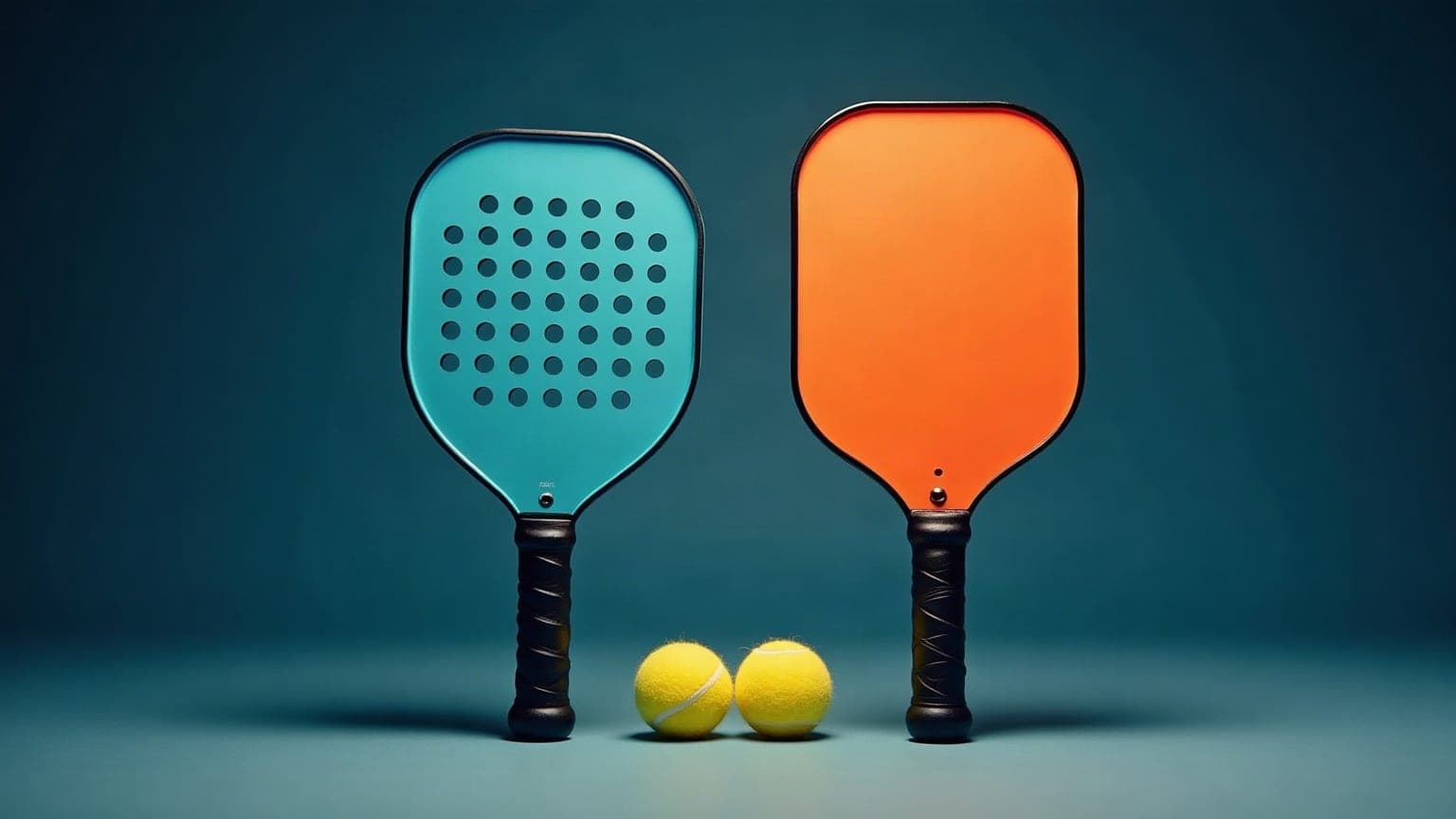
Both sports use a solid paddle rather than a strung racquet, which means neither one requires restringing the way a tennis racquet does, and both are genuinely lower-maintenance than a traditional racquet sport for that reason. Beyond that similarity, the equipment diverges quickly. A padel paddle is perforated with a pattern of holes and is paired with a pressurized ball similar in size to a tennis ball but with noticeably less bounce, built specifically to play well off the court's walls. A pickleball paddle is paired with a hard, perforated plastic ball closer in feel to a wiffle ball, light enough that it does not travel especially fast even when struck firmly.
That difference in the ball is worth dwelling on, since it explains a lot of how each sport actually feels to play. A padel ball's lower bounce and heavier feel reward a controlled, compact swing and reading the wall rebound correctly. A pickleball's light plastic ball rewards touch and placement near the net far more than raw swing speed, which is part of why the sport is often recommended to someone recovering from a shoulder or wrist issue that makes a heavier racquet sport uncomfortable.
Neither sport requires much protective gear beyond athletic shoes with good court grip, and neither paddle needs the kind of ongoing maintenance a strung racquet does, so the equipment cost to try either sport once, if a venue rents gear, is fairly low compared with a sport that requires its own specialized shoes or protective equipment from day one. For the full rundown on pickleball's paddle, ball and court dimensions specifically, see our guide to pickleball for beginners, or for more on padel's court and equipment on their own, see what is padel.
Scoring
Padel scoring
Padel scores exactly like tennis: 15, 30, 40 and game, with a two-point margin required from deuce, and sets typically won at six games with a tiebreak if the score reaches six games apiece. Anyone who has ever watched or played tennis can follow a padel scoreboard immediately without learning anything new.
Pickleball scoring
Pickleball scores to 11 points, win by two, using its own system that has no direct tennis equivalent. In traditional pickleball scoring, only the serving side can add to its score, so a rally lost while receiving does not cost points; it simply passes the serve to the other side. Some pickleball formats use rally scoring instead, where either side can score on any rally regardless of who served, which is worth confirming before a match starts since it changes the pace of the game noticeably.
For someone who already knows tennis, padel's scoreboard is genuinely a five-minute learning curve, while pickleball's serve-only scoring takes a little longer to get used to simply because it has no tennis equivalent to fall back on. Neither system is more complicated once it clicks; it is only the unfamiliarity of pickleball's version, to a tennis player specifically, that makes it feel like the bigger adjustment at first.
The rule that shapes each game
Every racquet sport has one rule that ends up defining how it is actually played at a practical level, more than the court dimensions or the equipment do. Understanding this one rule in each sport is a faster way to understand the actual difference between them than memorizing every line on the court, since it is the rule that decides how long a typical point lasts and what a winning strategy actually looks like.
Padel's walls
In padel, the walls are that rule. The ball can be played off the back or side walls after it has first bounced once on the court, which extends rallies well beyond what an open court would allow and rewards court position and teamwork between doubles partners over pure power. A shot that would be a clean winner on an open court might come right back into play in padel, so a padel point often keeps going until someone actually forces an error rather than simply hitting the ball out of reach.
Pickleball's kitchen
In pickleball, the defining rule is the non-volley zone, almost universally nicknamed "the kitchen," a section next to the net on each side of the court where players cannot hit the ball out of the air. They have to let it bounce first, or step back out of the zone, before volleying it. That rule stops either team from simply crowding the net and smashing every ball downward, which keeps the game from turning into a pure reflex contest at close range. It is covered in more depth, along with the double-bounce rule that works alongside it, in our pickleball for beginners guide.
Which is easier for a true beginner
Both sports are marketed as easier to learn than tennis, and that claim holds up, just for different reasons in each case.
Pickleball for a true beginner
Pickleball's smaller court, simple underhand serve and forgiving double-bounce rule mean most beginners are rallying comfortably within a single session. There is very little standing between picking up a paddle for the first time and playing a real, if slow, point against another beginner.
Padel for a true beginner
Padel's walls do something similar from a different angle. Because a mishit ball can still come back into play off a wall instead of simply sailing past the baseline, new players get more chances during a single rally than they would on an open court, which softens the learning curve in its own way even though the enclosed space and doubles-only format take a little longer to get comfortable with than an open court does. Neither sport asks a true beginner to master much before their first real rally, which is a large part of why both have grown so quickly in recent years.
Availability: which is easier to find near you
Pickleball has spread faster across the United States over the past several years, so outdoor and indoor courts tend to be considerably easier to find in most American cities, including dedicated pickleball facilities as well as courts added to existing tennis clubs and community centers. Padel is much more established in Europe and Latin America and is still in an earlier stage of expanding in the U.S., so a dedicated padel court can be harder to track down depending on where you live, and it is worth checking ahead of time whether a venue near you actually has padel courts before planning an outing around it. That gap is closing as more American venues add padel, but as of now it remains real, and it is one of the more practical reasons someone might end up trying pickleball first simply because a court happens to be closer.
Trying both near New Orleans
Pickle N Pins in Metairie has indoor courts for both sports under one roof, and both can be booked directly, so you do not need to travel to two different venues to compare them for yourself. Pickle N Pins says it was the first venue in Metairie to add padel courts, and as of this writing it appears to be the only currently open, dedicated padel venue in the wider metro area; a Warehouse District venue, New Orleans Padel Club, lists itself as opening soon on its own site rather than as currently open, so it is worth checking directly with them before planning a visit around it.
Pickleball has more company in the area: The Exchange, in New Orleans' Lower Garden District, and NOLA PicklePlex, near the Jefferson Parish and New Orleans line, both run seven-court dedicated pickleball facilities of their own. Neither combines pickleball with padel, so Pickle N Pins remains the straightforward option if trying both sports side by side, in the same visit, is the actual goal. For a full walkthrough of the sport more people already know, see our guide to where to play pickleball near New Orleans. Current court pricing for both sports is on the pricing page.
A practical way to use one visit to settle the question for a group: book one court for each sport back to back, split the group so everyone gets time on both, and compare notes over food afterward rather than trying to decide in the abstract beforehand. Because both sports are played on courts in the same building, there is no travel time between the two halves of that comparison, which is not something either of the single-sport pickleball facilities in the area can offer for padel, since neither one has padel courts at all.
The bottom line
Neither sport is better than the other in any absolute sense; they solve slightly different problems for slightly different players. If you want a sport that is already nearly universal across the U.S., easy to find a court for, and quick to pick up in a single session, pickleball is the more available starting point almost anywhere you live. If you are drawn to the longer, more strategic rallies that come from a walled-in court, and you can actually find one nearby, padel rewards the same kind of doubles teamwork with a genuinely different rhythm and pace.
Trying both, when a venue happens to have them side by side, is the most honest way to find out which one you actually prefer, rather than picking based on which is more popular or which one a friend already plays. If your group is torn between the two, playing an hour of each back to back, with the same people, on the same day, tends to settle the question faster than reading any comparison article, including this one.